

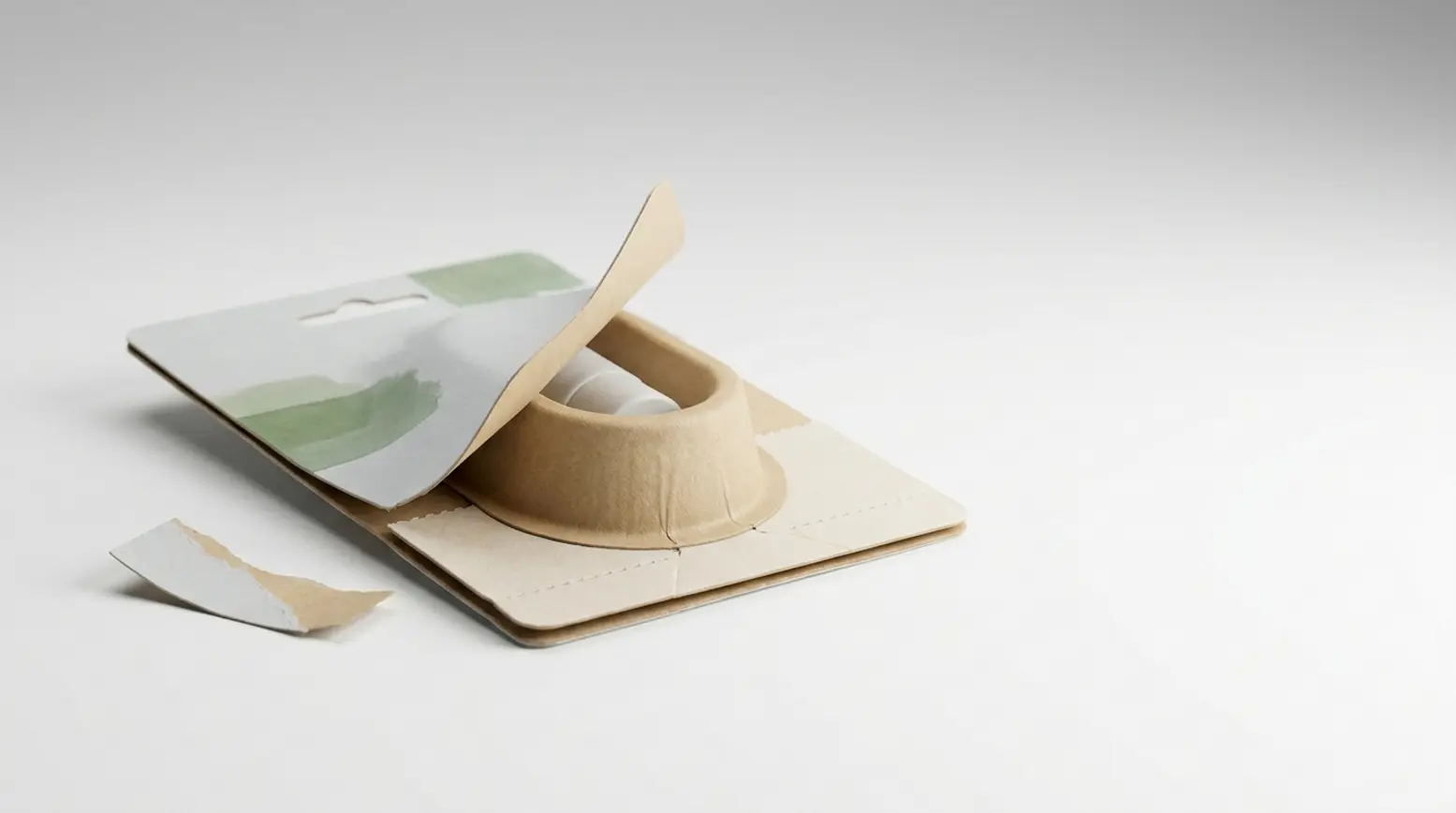

An all-paper blister card is built from the inside out. First comes the product, followed by the formed paper cup that creates the cavity. Next is the blister card that supports the cup, then the joining method that holds the paper parts together, and finally the print and finish. In practice, the primary choice is simple: does the product need a paper cup trapped between two paper layers, or a paper cup sealed directly to a single card? That is the fastest way to understand all-paper blister card construction and compare real packaging options.
• The paper cup is the inner, shaped part that holds the product and creates depth.
• The blister card is the flat or folded board that supports the cup and carries print, instructions, and retail features.
• The joining layer determines how the paper parts become a single package, directly affecting assembly and opening behavior.
• Both a trapped cup and a directly sealed cup can work well, as performance depends on the overall design.
• The most productive supplier discussion begins with structure, then moves to opening, artwork, and material usage.
What all-paper blister card construction means in practice
All-paper blister card construction is a layered, paper packaging format. It typically includes the product, a formed paper cup, a blister card, a joining area, and an outer finish. Each part serves a specific purpose, meaning the package should be evaluated as a single system. This is crucial because people often compare just one feature, such as the card or the seal, when the true result depends on how all the layers work together.
The easiest way to explain all-paper blister construction is to start at the center and move outward. This approach allows engineers to see the physical stack, helps product managers understand the design impact, and enables procurement teams to compare part counts and supplier scope more clearly.
Why this matters before specification
Structural choices should be made early because they affect the opening experience, component count, print space, and assembly flow. They also shape how the package is discussed with a supplier. By beginning the first technical conversation with package structure, teams can compare realistic options faster and avoid confusion later in the project.
The product and the paper cup in all-paper blister card construction
The first layer is always the product. Around it sits the formed paper cup, the inner three-dimensional component that creates the cavity and keeps the item in place. Within the various paper blister card layers, the cup provides the package with its visible depth and shape, making it the natural starting point for the overall design.
If the cup is removed, the main cavity also disappears, meaning the product will need support from another paper structure. As a result, the decision to use a cup should carefully match the product's geometry, the required retention, and the way the package will be opened and displayed.
What the paper cup does
The paper cup plays a clear structural role. It positions the product, creates depth, and supports the front shape of the package. Furthermore, it can enhance product visibility when the design includes cutouts, or when the overall package form improves shelf display. For these reasons, the cup is much more than a visual feature; it is a highly functional component of the packaging stack.
What changes if there is no cup
Without a cup, product retention must come from another board structure or a different paper-based design choice. This shift can fundamentally change how the item is held, how the front looks, and how the user accesses the product. Therefore, the decision is not just about the material used. It is also about physical support and overall package behavior.
The blister card layers in all-paper blister card construction
The blister card is the flat or folded paperboard surrounding the cup. It supports the cup while carrying branding, instructions, legal text, and retail features like hang holes or opening marks. Because the card is a structural component, it should never be viewed as mere decoration. Its architecture dictates how many paper layers surround the cup and influences how the package opens.
Our range includes several card formats, such as single-card, fold-over, and separate front and back layouts. If you want to review broader packaging components for a complete system view, it helps to see these card options as functional paper blister components that actively shape both production and package usability.
Single-card paper blister
A single-card paper blister uses one main card to directly support the paper cup. This creates a simpler layer stack, as there is only one primary board layer instead of two. The sealing area between the paper cup and the card is also different, which can alter assembly and opening behavior. While this approach may support a cleaner structure in certain projects, the final result ultimately depends on the specific package design.
Fold-over blister card
A fold-over blister card uses a single piece of board that folds over to create two paper layers around the cup zone. This design can support a trapped cup structure while keeping the front and back panels connected. If you want to compare this card architecture in more detail, our fold-over blister cards page illustrates how this format fits within a broader range of components.
Front and back blister card
A front and back blister card uses two separate cards rather than one folded board. While the finished package can look similar to a fold-over blister card from the outside, the manufacturing setup, artwork layout, and assembly route differ significantly because the cards are separate parts. This option is often important for procurement teams, as it directly impacts part count and handling processes.
Joining methods in all-paper blister card construction
The joining layer is the interface that turns separate paper parts into one finished package. This step is completely distinct from cup forming. That distinction matters because the two processes are frequently confused. In simple terms, the cup provides the shape, while the joining method connects the paper parts.
In all-paper blister card construction, there are two commonly used routes. One route traps the cup between two paper layers, while the other attaches the cup directly to a single card. Both methods should be reviewed as complete structures, because the bonding area, card layout, and product shape all influence the final result.
Trapped cup construction with cold sealing
One standard route uses a paper cup trapped between two paper layers. In this structure, the cup sits between board layers that are joined via cold sealing. This is a pressure-based, card-to-card joining method that does not form the cup itself. In a cold-seal paper blister, the second paper layer can protect the cup flange and provide additional board area for structure, printing, and retail functionality.
Because that extra layer adds another structural component, it must have a clearly defined role. We have extensive experience with cold sealing, which is why we know the joining layer should always be evaluated alongside the cup, the card, and the overall product shape.
Direct cup attachment with heat sealing
The second primary route is direct cup attachment to a single card. Here, the paper cup is sealed straight onto the board. This creates a simpler layer stack with a distinct bonding interface, which can also change how the package opens and how the card carries the load around the cavity. To place this route in a wider context, our all-paper packaging construction page explains how these structures fit into broader all-paper packaging design choices.
Why bond choice changes pack behavior
One bonding route is not inherently better than the other. Package performance depends on the comprehensive design, including the card, the cup, the seal area, and the product geometry. While easy opening is often a design goal, a single layer choice alone does not guarantee it. Opening behavior can shift due to folds, perforations, flange position, and the physical path the user takes to reach the product.
The joining layer can also be described as a paper blister adhesive interface, although the exact construction varies by design. What matters most is how that interface interacts with the total structure. Consequently, the card design and the joining method should always be reviewed together.
Finishing choices that complete all-paper blister card construction
Finishing serves as the outer visual and tactile layer of the package. This includes printing and selected surface effects tailored to fit the forming and sealing processes. Finish planning should begin early because folds, cuts, sealing zones, and the formed cup will all impact the final artwork. If finishing is treated as an afterthought, important technical areas may be obstructed, or the messaging could become harder to read on the final package.
Print layout and sealing zones
Artwork requires a realistic structural map. The design team needs to know exactly where the cup sits, where the joining areas are located, and where the opening points and folds will be placed. In this way, branding remains clear while technical zones continue to function properly. This is precisely why the paper blister card layers should be reviewed before the final artwork process begins.
Shelf impact and communication space
Card layout also dictates how much room is available for branding, instructions, and legal text. A trapped structure may yield different front and back communication areas compared to a single-card format. Therefore, shelf impact is directly linked to structural design, as all graphics must accommodate the real package shape and its usable print area.
How to choose the right all-paper blister card construction for your product
The best initial question is a practical one: Does your product require a trapped, two-layer cup structure, or a directly sealed, single-card cup structure? This question turns a broad packaging concept into a clear technical starting point, helping teams compare package designs in a fair and structured manner.
Start with the primary supplier question
Always ask whether the product needs the cup trapped between two paper layers or attached directly to a single card. This decision directly impacts product retention, opening behavior, assembly flow, and available communication space. It also helps teams compare a cold-seal paper blister against a direct-attachment design without conflating cup forming with the joining process.
Then review the following points
Next, evaluate the product geometry, required opening behavior, card architecture, assembly method, branding space, and material usage across the actual package dimensions. While a single card might simplify the structure, it also eliminates the beneficial functions a second card could provide. For this reason, material usage should always be compared across the entire design rather than layer by layer.
• Product geometry affects cup depth, retention, and overall package shape.
• Opening behavior relies on the complete structure, including folds, seal areas, and access points.
• Card architecture influences part count, artwork layout, and assembly handling.
• Material usage must be judged across the fully finished package to ensure accurate comparisons.
When a second card is beneficial and when it complicates the job
A second card can provide added strength, cover the cup flange, expand communication space, or shape the opening path. However, it also changes the assembly and artwork setup. Therefore, any extra layer must serve a clear structural or functional purpose. If it does not, the package may end up being unnecessarily complex.
What this means for component scope and supplier choice
This topic extends far beyond mere paper choice. It is also about determining how many parts are needed, how they fit together, and whether a single supplier can effectively align the cup, card, joining method, and finishing. Because we produce our own components, we can discuss cards, cup formats, primary packaging, secondary packaging, and machinery as unified elements of a single packaging system whenever needed.
Why component range matters
When single-card, fold-over, and separate front-and-back blister card options are discussed alongside the joining method, the packaging plan becomes much easier to grasp. Engineers gain a clearer view of the physical stack, while product managers can better understand how structure influences branding and the opening experience. Additionally, procurement teams can compare scope with fewer gaps since the component logic is well-defined from the start.
Practical next steps
If you are currently comparing structures, bring your product shape, opening requirements, preferred card layout, and cup attachment route to your very first supplier discussion. This preparation allows the project to move swiftly from a basic concept to a workable packaging plan. If you want to review your structural options in practical terms, feel free to contact us to discuss your specific needs with our team.
FAQ about all-paper blister card construction
What is the difference between a trapped cup and a directly sealed cup?
A trapped cup sits between two paper layers that are joined together, whereas a directly sealed cup attaches straight to a single card. This fundamental difference changes the layer stack, the bonding area, and often the way the package opens and is assembled.
When does a fold-over blister card make sense?
A fold-over blister card is ideal when you want two paper layers built from a single piece of board. It supports both structure and artwork planning in one seamless, connected format. However, the right choice ultimately depends on your product's shape, opening needs, and assembly flow.
Does a single card always use less material?
No, this should not be automatically assumed. While a single card removes one paper layer, the final material usage depends on the board size, cup design, structural support needs, and total package dimensions. The most accurate comparison is always based on the complete, actual package design.
How does opening behavior change with card construction?
Opening behavior can change significantly because folds, perforations, seal areas, cup support, and access points all impact how a user reaches the product. While a package can certainly be designed for easier opening, the final result relies on the complete structure, making early review essential.
What should I prepare before speaking with a supplier?
Be sure to bring the product dimensions, product weight, preferred opening style, specific retail needs, and any limitations regarding card layout or communication space. Providing this information gives the supplier enough detail to practically compare a trapped cup route with a direct attachment design.
Request a free sample now!


