

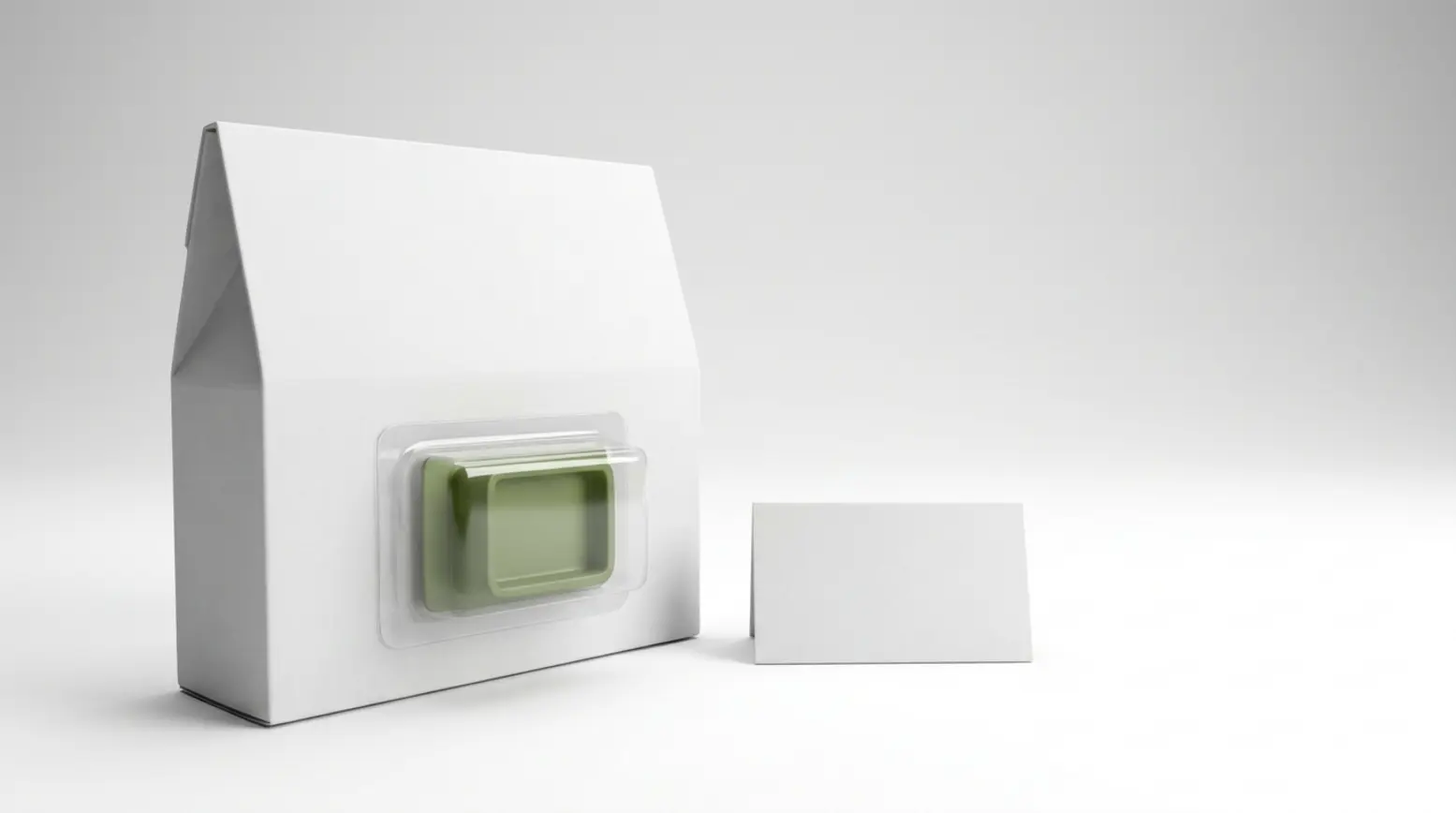

A blister-carton hybrid is a retail pack that combines a carton component with a formed cup or blister. Because the term is used in various ways, the first step is always to define the exact construction. In practice, this could mean a cup mounted on a carton, a carton with a window and a formed part behind it, or a carded blister made from carton-grade board. This distinction matters because visibility, ease of opening, shelf presentation, and material separation after use all depend on the chosen structure.
• The term blister-carton hybrid can describe several pack types, so providing a sketch or sample helps avoid confusion.
• This format is ideal when brands need shelf impact, product visibility, and ample printed space in a single retail pack.
• Retail performance must be intentionally designed, as a pack may need to hang, stand, or stack.
• Opening mechanisms, tamper evidence, and material separation depend on the specific structure, cup material, and joining method.
• A clear brief saves time, especially when it clearly defines visibility requirements, store display methods, opening features, and post-use material separation.
What a blister-carton hybrid can mean in retail packaging
The term blister-carton hybrid is broad, which is why buyers and suppliers often picture entirely different pack types when using the same terminology. Some envision a folding carton blister with a formed cup mounted into the board. Others are thinking of a carton with a blister insert placed behind a cutout or window. Additionally, some use the term to describe a blister card carton made with stronger paperboard, even though it behaves more like a traditional blister card construction than a standard box. Because the terminology can be ambiguous, it is wise to reference a drawing, sample, or photo before comparing costs, production methods, or functionality.
A formed cup mounted on or in a carton
In this version, the cup securely holds the product while the carton provides shape, structural integrity, and printable area. This is particularly useful when an item requires a secure holder, and the brand needs ample space for instructions, marketing claims, or shelf communication. Furthermore, it can offer a more enclosed, premium look than a simple carded blister.
A carton with a window and a formed cup behind it
In this approach, the carton dictates the exterior shape and the primary front panel. The formed component keeps the item securely in place behind the opening. A window carton blister allows you to reveal only specific parts of the product to shoppers, ensuring the shelf face remains neat and highly controlled.
A carded blister made with carton-grade board
Some professionals refer to this as a carton blister or cardboard blister packaging. Even so, it typically functions more like blister carton packaging based on card construction rather than a fully enclosed carton box. The board acts as the primary backing card, while the formed portion presents and protects the product on the front.
These three distinct meanings highlight exactly why context matters. If your project uses a carton as a structural and branding element within a retail format, it is helpful to review carton packaging for shelf presentation before defining how the cup should integrate with it.
Why brands use blister-carton hybrids for shelf impact
Brands use a blister-carton hybrid when they want printed carton surfaces and controlled product presentation combined in a single pack. The carton provides space for branding, legal text, instructions, and promotional messages. Meanwhile, the blister component holds the product securely in place and enhances visibility on the shelf. As a result, this hybrid retail packaging format helps shoppers understand the product quickly while keeping the front display clean and organized.
When high visibility helps the product
This format is incredibly common in cosmetics, electronics accessories, DIY products, stationery, toys, home goods, and small garden tools. In these categories, the product itself often helps sell the package, making high visibility essential. While a carton blister pack can showcase more of the item than a fully closed box, the final result still heavily depends on the layout, cup shape, and material choices.
Where the carton adds value beyond product display
The carton component adds far more than just decoration. It provides extra surface area for printed information, improves structural enclosure, and helps shape the package for optimal shelf presentation. This is especially important when the pack requires a stronger front panel, detailed user guidance, or a cleaner aesthetic than a basic blister card can offer. For these reasons, high-visibility carton packaging is frequently chosen for products that demand both striking presentation and clear explanation at retail.
However, optimal visibility is never automatic. A transparent cup displays the product directly, whereas a paper-based cup naturally shows less. A cup positioned behind a window reveals only a carefully selected area. Therefore, product display strategies should be discussed early in the process, as they will dictate the entire design direction.
How a blister-carton hybrid works as a structure
To make a blister-carton hybrid work effectively, you must clearly define the role of each component from the very beginning. The carton provides shape, stiffness, print space, and retail presence. In contrast, the cup holds, presents, or protects the product. When these elements are developed in tandem, the resulting pack is easier to test, manufacture, and display in stores. This collaborative approach also helps engineers and sourcing teams compare various options in a highly practical way.
The role of the carton
The carton serves as much more than just a printed outer layer. It actively influences shelf presence, structural strength, and how securely the product is enclosed. Depending on the retail strategy, it may also need to support hanging, standing, or stacking. In certain projects, the carton plays the primary structural role, while in others, it functions more as a printed shell wrapped around a formed holder.
The board decision
Selecting the right board depends on required stiffness, folding behavior, desired print quality, and overall product weight. The carton component must also integrate seamlessly with the formed part and the intended assembly method. For technical planning, our specialized approach to carton components can help accurately define how the paperboard will support the complete package structure.
The cup decision
The formed cup can be transparent, paper-based, or primarily hidden behind the board. A transparent cup provides a direct, unobstructed view of the product, making it ideal for projects where visual access drives sales. Conversely, a paper-based cup can significantly reduce visible plastic when it suits the brand's concept. Finally, a hidden cup offers maximum control over shelf presentation by ensuring only selected portions of the item are displayed.
Trapped cup or face-sealed cup
A trapped cup sits securely between paper layers or within the inner board structure. A face-sealed cup, however, is sealed directly onto a visible board surface, closely resembling a classic blister card style. These specific design choices affect the final appearance, the assembly process, and how the consumer ultimately opens the pack. The right option always depends on the product itself, the desired aesthetic on the shelf, and the required level of enclosure.
The joining method matters just as much. Cold sealing is particularly relevant in certain trapped constructions where coated board layers are joined under pressure around a formed part. We actually invented the cold seal technique, and we have over 25 years of experience producing cold-seal thermoformed blister packaging. Still, not every blister carton or carton blister pack uses the exact same process, meaning this detail should be defined on a case-by-case basis.
How a blister-carton hybrid should hang, stand, or stack
Retail display mode is a deliberate design choice that must be decided early on. A blister-carton hybrid does not automatically hang, stand, or stack well simply because a carton is involved. Actual shelf performance depends on the board layout, product weight, overall pack footprint, and the precise position of the formed holder. Therefore, category requirements and store handling expectations must be included in the brief from the very first concept stage.
Hanging
If the package is intended to hang, the structure must remain stable under the product's weight, and the hanging feature must be positioned perfectly. Otherwise, the pack might lean, twist, or face sideways while on the shelf. This structural balance is especially critical for electronics accessories, DIY products, and other retail items frequently sold on pegboards.
Standing
If the pack must stand on its own, it requires a stable base and a well-calculated center of gravity. Many formats are specifically developed as free-standing packaging, which secures the product its own dedicated shelf position without relying on hanging displays. Whenever space planning allows, this approach drastically improves shelf organization and product visibility.
Stacking
If the packaging needs to be stacked, the front, back, edges, and top-load capacity all require careful attention. For instance, a cup that projects too far forward can compromise stability, while weak board edges can easily create problems during transport or in-store display. Because of these factors, stackability should always be verified before the final structure is locked in, particularly if the project aims for a flawlessly neat shelf layout across multiple units.
Opening, protection, and end of life in blister-carton hybrid design
The opening mechanism should be planned intentionally, as different structural formats prompt entirely different user actions. One pack may require tearing through the carded area, while another might open just like a traditional carton. A carton featuring a blister insert may require the user to remove an inner holder, whereas a different format might prompt them to peel apart a sealed cup. These variations greatly affect ease of use, product security, and what ultimately happens after the pack is empty.
Opening behavior
An easy-opening feature can significantly improve the user experience, but it must always be carefully balanced with pack strength and product security. For example, a lightweight cosmetic item will likely need a vastly different opening style than a heavy, sharp tool accessory. Therefore, defining the expected user action before locking down the structure is highly recommended.
Tamper evidence and theft resistance
Tamper evidence and theft resistance are often critical goals in retail environments. A trapped cup, a face-sealed construction, or enclosed carton flaps can all support product protection in distinctly different ways. The correct approach depends heavily on the specific product, the expected store setting, and how the end user should access the item at home. It is much better to treat these as fundamental design questions rather than assuming every blister carton packaging format will perform exactly the same way.
Material separation after use
A package's end of life is dictated by the cup material, board coatings, applied adhesives, and local recycling collection systems. Because of these variables, it is inaccurate to claim that every cardboard blister packaging concept is fully recyclable as a single, unified piece. A much better question to ask is whether the consumer can separate the paper and plastic parts easily after opening, and whether those chosen materials actually fit into local waste streams. Because we design the pack and manufacture the components ourselves, we can support the entire packaging system and accurately assess how all parts work together. Whenever a concept allows, we also provide all-paper packaging options, which replace the standard transparent PET blister cup with a formed paper alternative while keeping many of the original pack's structural properties intact.
Questions to define before you request a concept
Before you request a concept, it is crucial to define the basics first. This proactive step saves immense time because the term blister-carton hybrid is far too broad on its own. Defining the basics also ensures that brand teams, engineers, and retail buyers all describe the exact same structure in the same unified way. Ultimately, a crystal-clear brief leads to faster comparisons, fewer misunderstandings, and much better sample reviews.
• Visibility: How much of the product must be visible on the shelf?
• Store display: Must the package hang, stand, or stack?
• Opening: How should the user open the package at home?
• Material separation: Which components need to separate easily after use?
If you can answer these four foundational questions, the next phase of discussion will be significantly more practical. A physical sample is incredibly helpful at this stage, allowing you to request a sample to tangibly compare structural stiffness, visibility, and opening mechanics before committing to a specific design concept.
Simple comparison of common formats
A mounted cup on a carton utilizes a formed holder positioned either on or directly inside the board structure. Visibility ranges from medium to high, making it a perfect fit when ample branding space and robust product support are equally important.
A carton featuring a window with a cup behind it relies on an outer carton shell containing a cutout, with the formed component placed securely behind that opening. Visibility is highly selective and controlled, suiting projects where a distinct shelf silhouette and a partial product reveal are both essential.
A carded blister using carton-grade board functions more like a folding carton blister or a heavy-duty blister card format. Front visibility is usually excellent, and this style is optimal when the project needs to behave more like a durable display card than a standard box.
FAQ about blister-carton hybrid packaging
Is a blister carton exactly the same as a folding carton blister? No. The term is applied to several different constructions, so it is always better to define the pack using a sketch, a physical sample, or a highly detailed description prior to specification.
Does every blister carton feature a transparent cup? No. The cup can be fully transparent, paper-based, or partially hidden behind a die-cut window. Ultimately, product visibility is completely dependent on the chosen structure and materials.
Is cold sealing always used in this type of package? No. Cold sealing is primarily relevant for specific trapped constructions where specially coated board layers are joined under high pressure. Other hybrid formats frequently use completely different joining methods.
Can every carton blister pack stand on its own on the shelf? No. Free-standing performance must be intentionally engineered into the design. The base footprint, board strength, and internal product positioning all dramatically affect shelf stability.
Is every cardboard blister packaging format inherently easy to recycle? No. What happens after the pack is discarded depends entirely on the materials used, how those materials are joined, and the capabilities of the local collection system. Planning for material separation after use should be a fundamental part of every initial design brief.
Request a free sample now!


