

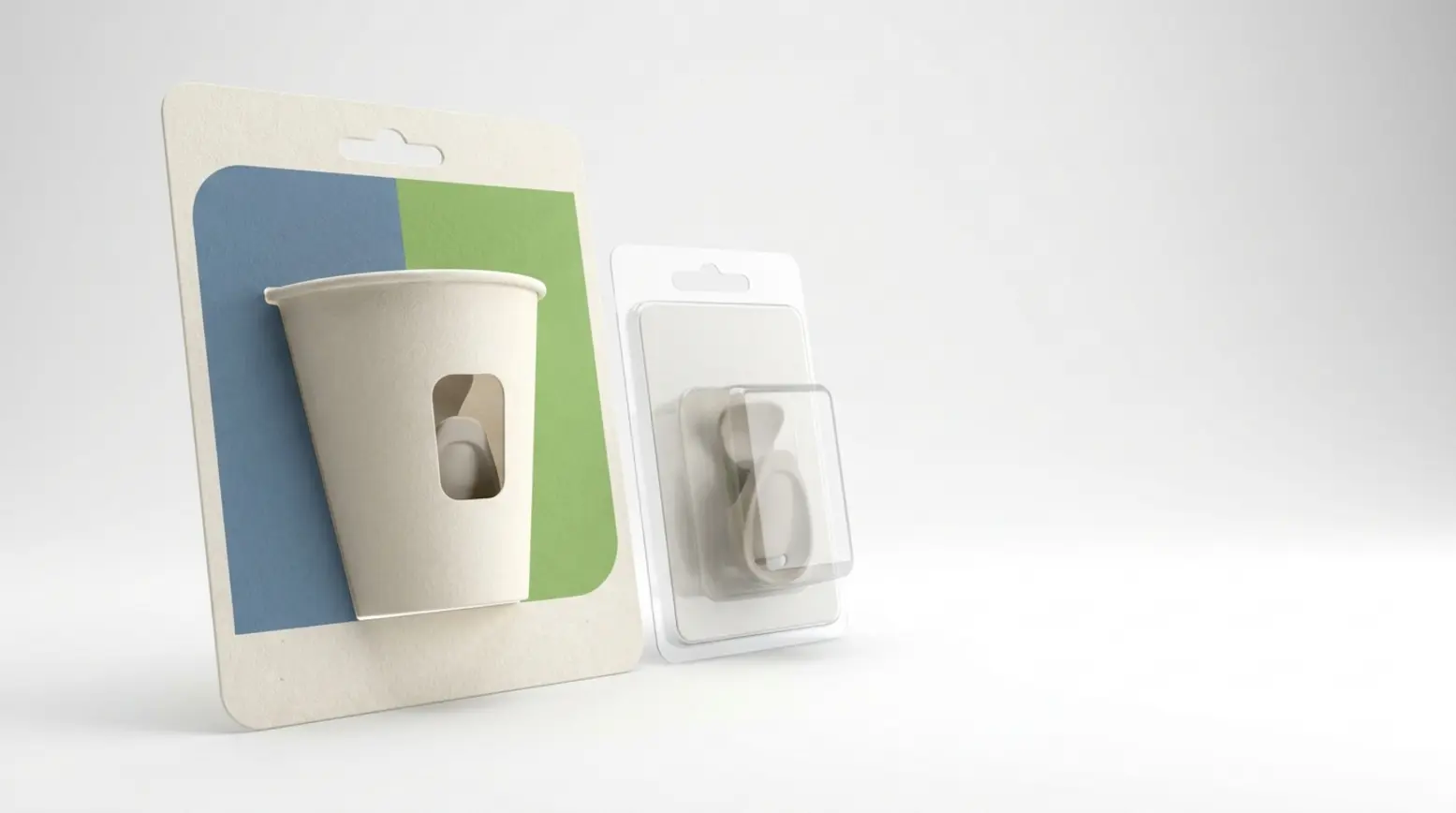

Paper often provides a better solution than PET when packaging must sell through print, as more of the visible front can feature brand colors, claims, instructions, and variant cues. In simple terms, paper blister print quality proves stronger when a usable print surface matters more than a full product view. PET still plays a clear role when shoppers need to see the actual item first, meaning the right choice depends on what drives the purchasing decision on the shelf.
• Paper can transform more of the packaging's front into a communication area, allowing small packs to carry clearer branding and information.
• PET remains useful when product visibility is the primary reason consumers choose a package.
• The forming process alters flat artwork, so small text and precise details should be kept out of risky shaped zones.
• Finishes such as matte, gloss, spot varnishing, and embossing work best when they align with the actual structure and production route.
• Early prepress and approval on the actual formed pack help avoid late design changes and printing issues.
Paper blister print quality starts with a usable brand surface
When printed communication does most of the selling, paper typically offers a larger visible area than a clear PET blister cup. With all-paper packaging, more of the front can feature paper packaging graphics, product details, usage instructions, and color coding. Consequently, the primary message does not need to reside solely on the backing card, allowing the front of the pack to work harder on the shelf.
This shifts the role of the packaging face. A clear PET blister primarily showcases the product, whereas a paper blister can turn that same space into a dedicated print surface. As a result, brand blocking, claims visibility, and version recognition become much clearer, especially in categories where shoppers make rapid decisions.
What changes when the front of the pack becomes printable
On many retail packages, the blister card carries most of the messaging because the front cup remains transparent. This can severely limit layout choices, particularly on smaller formats. When the visible front can also be printed, the design gains more room for visual hierarchy, ensuring the main message, supporting details, and product imagery each have a clear, designated place.
This flexibility is crucial when a single pack must display multiple elements simultaneously, such as instructions, variant names, legal text, icons, and claims. A larger print surface supports better spacing and improved readability, allowing the package to communicate more effectively without appearing cluttered.
When PET still plays the stronger role
Paper is not always the superior route. If the actual product must be seen first, PET often remains the stronger option since transparency serves as the primary sales tool. This is common in categories where the shape, color, texture, or size of the item builds trust and helps consumers choose quickly.
The trade-off is purely practical. If printed messaging drives shelf success, paper consistently adds value. However, if seeing the product drives that success, PET may still be the better choice.
Where paper blister print quality creates more communication value
The primary advantage is a larger, continuous front area for communication. This helps a small package work harder, as more of the visible face can feature branding, instructions, imagery, and claims. In busy retail categories, this matters significantly because shoppers often scan shelves quickly and compare many similar products in a very short time.
Exceptional paper blister print quality also supports clearer range logic. If a brand offers several variants, the design can utilize stronger color coding, clearer labels, and easier visual grouping. Consequently, shoppers can spot the right version faster, making the retail shelf look much more organized.
More room for claims, instructions, and variant coding
Small retail packs often need to explain a lot of information. A larger printable area helps separate the primary brand promise from secondary details, making the front feel much clearer. This extra space is invaluable for size cues, scent names, usage instructions, strength levels, and product differences that consumers must understand quickly.
Printed paper packaging can also improve clarity when several product variants sit next to one another. Having more room for colors, icons, and names makes it easier to keep each version distinct without sacrificing readability.
A stronger continuous brand world on the shelf
Paper can create a more unified front because more of the visible packaging carries graphics instead of clear material. This allows a product family to look more connected, ultimately supporting shelf recognition and range navigation. Of course, the final result depends on the structure, print, and finish working perfectly together; the material alone does not guarantee a premium look.
Still, when a package needs to sell through visual communication, the wider graphic area makes a distinct difference. This is exactly where a printed paper blister often creates more shelf value than a transparent plastic dome.
How paper blister print quality changes on formed surfaces
This is where many projects become highly technical. Artwork starts flat, but the package eventually becomes a shaped three-dimensional object. Because of this, paper blister print quality depends heavily on how the design behaves after forming, rather than just how it looks in a flat file. A line might move, a shape could stretch, and a graphic may sit differently once the material takes on depth.
Printing a paper blister on a formed part requires careful planning around the final geometry. This remains vital for both commercial design and production control, as a great flat layout can easily lose clarity on the actual finished package.
Why flat artwork can shift after forming
A design might look perfect on screen or on a flat proof, yet still distort after forming. Curves, depth, and shaped corners can drastically affect spacing, image positioning, and edge alignment. Therefore, artwork must always be prepared for the finished package shape rather than just the unformed sheet.
This matters even more when the blister cup itself becomes part of the front design. While a printed formed paper cup adds valuable communication space, it demands meticulous planning. Decoration on a shaped area is far less forgiving than printing on a flat backing card.
What to keep out of high-risk forming zones
Fine details require extreme caution. Small text, thin lines, tiny icons, and alignment-sensitive graphics should stay away from high-risk forming zones whenever possible. If those elements shift or stretch, the packaging can lose visual clarity almost instantly. The same warning applies to barcodes or QR codes that must remain easy to read and scan.
Cuts, folds, windows, and sealing areas also dictate safe artwork zones. Because of these variables, the design and engineering teams should agree early on which parts are stable and which are risky. Operating this way ensures that graphics stay well within the true physical limits of the structure.
When the formed paper cup can be part of the design
In certain structural designs, the formed cup itself can carry print and serve as a highly visible design surface. This approach expands the front communication area and provides greater freedom for branding and imagery. However, it only works well when the selected manufacturing route supports printing on that specific component in a highly controlled manner.
It is always better to design based on the actual package shape, because even minor changes to cup depth, edge curvature, or the sealing area can drastically affect where graphics land. As a result, structural confirmation must occur long before the final artwork gets locked in.
Paper blister print quality and finishing choices
Finishing techniques can dramatically improve contrast, tactile feel, and visual focus, but they must align with the actual production route. We support this process with in-house printing and finishing, ensuring that design choices stay true to real-world production behavior. If you want to explore broader printing and finishing options, that page explains the available methods in much greater detail.
To maximize paper blister print quality, surface finishes should enhance communication and remain completely stable through forming, cutting, and sealing. This is precisely why it is better to choose finishing effects with a clear purpose and test them against the final structure early in the process.
Matte and gloss for contrast on the packaging print surface
Matte and gloss finishes can intuitively guide the consumer's eye by reflecting light in fundamentally different ways. A matte area can feel calm and naturally reduce visual noise, whereas a gloss area can draw sharp focus to a brand name, claim, or product image. This technique proves highly effective on a printed paper blister, where the front area already performs a significant amount of the communication work.
The final result heavily depends on handling and physical shape. A finish that looks striking on a flat sample may behave quite differently near edges or formed zones, so it should always be reviewed on the actual constructed package.
Spot varnishing for selective emphasis
Spot varnishing on packaging works best when highlighting a specific element, such as a logo, product image, or brief claim. This targeted approach often provides cleaner contrast than coating the entire surface. It also supports a much more controlled visual hierarchy, which proves particularly useful on packages carrying extensive information.
Print registration matters immensely here. If the varnish must perfectly align with printed details, die cuts, or formed structural features, the design requires tight control right from the start. Therefore, selective varnishing should be planned early and never added as an afterthought.
Tactile packaging finishes and embossing
A tactile packaging finish can introduce texture and depth, supporting a more refined, premium feel when it suits the structural design and production route. However, subsequent handling, sealing, and forming can severely limit where these physical effects work best. For that reason, tactile choices must follow production reality rather than simply relying on visual intent.
Embossing on packaging can also add tremendous value, but the behavior of the paperboard matters significantly. Certain areas and geometric shapes support embossing far better than others, especially when the package includes deep formed sections. The simplest rule is that finishing ideas must match what the chosen material can consistently hold during mass production.
Why paper blister print quality depends on packaging prepress
Prepress should begin well before every single graphic choice gets finalized. It is the vital stage where the physical structure and the visual artwork are cross-checked together, meaning it plays a central role in paper blister print quality. Our packaging prepress process thoroughly aligns dielines, safe print areas, forming zones, cuts, and sealing locations long before production begins.
This level of early control is particularly important when printed areas sit perilously close to shaped features or highly precise finishing effects. In these scenarios, even minimal printing shifts can become glaringly visible, making early prepress work essential for reducing the risk of costly late-stage changes.
Dielines, forming zones, cuts, and seal areas must match
The prepress phase rigorously verifies whether the artwork fits the actual package. This detailed review covers safe print areas, strictly prohibited zones, cut lines, fold lines, and exact seal positions. In simple terms, prepress ensures that the graphic file matches the true physical structure rather than merely an assumed one.
This step matters even more when dealing with formed paper surfaces. A flat file can look fantastic on screen yet still fail completely on the physical package if critical text sits too close to a curved edge or if a special finish crosses into an unstable forming area. Early checking drastically improves quality control and saves significant time later.
Start from the confirmed structure, not an assumed shape
Design teams often want to move incredibly fast, but the final artwork must always follow the confirmed package structure. If the blister cup's outline, depth, or seal area changes late in the process, the visual design might require major structural updates. Such delays slow the entire project down and reduce control over the final print quality.
It is much safer to lock down the physical structure as much as possible first. Once established, the graphic work can confidently develop around known manufacturing limits, giving designers, engineers, and brand teams a far stronger foundation for their decisions.
Registration-sensitive effects require extra care
Specific visual effects demand exact placement to work properly. This includes selective varnishing, highly detailed highlights, and any graphics placed very close to cuts, folds, die-cut windows, or formed structural features. These delicate areas require extra care because even the slightest movement can become glaringly obvious on the final package.
The exact same principle applies to critical text and barcodes. If a specific element is vital for reading, scanning, or guiding the consumer's product choice, it should remain in a highly stable, flat area whenever possible. Operating this way ensures that the prepress phase protects both design quality and everyday functionality.
Paper blister print quality during approval and proofing
Final approval should always be based on the actual formed package, not merely on a digital screen file or a flat printed proof. Crucial details like color accuracy, contrast, light reflection, shape effects, and physical touch can all change drastically after the forming process. Because of this, paper blister print quality should always be judged using a physical sample that genuinely matches the intended production route.
This stage is also where cross-functional teams can compare PET and paper options much more fairly. While a flat sample might suggest one specific result, the fully formed package demonstrates exactly what the retail shopper will actually see and hold in their hands.
Why flat proofs are simply not enough
Although a flat proof is certainly still useful, it simply cannot show everything. It fails to fully demonstrate how graphics wrap over varying depths, how gloss finishes react to light on a curved surface, or how a specific tactile packaging finish feels to the touch. As a result, signing off based solely on flat visual proofs carries significant, yet entirely avoidable, risk.
This remains especially true when the formed blister cup serves as an integral part of the front design. Small graphic shifts can negatively alter visual balance, reading order, and the overall perceived quality, so reviewing the actual formed package is critical before authorizing the final release.
A practical rule for final approval
We recommend using a very simple approval rule: confirm the physical structure first, involve the prepress team early, choose finishes that perfectly fit the manufacturing route, and approve the actual formed package before the final release. This diligent approach keeps your shelf goals completely aligned with production reality. If you would like to compare the print surface, texture, and formed graphics in hand before making a final decision, you can easily request a sample for a detailed review.
Related packaging design ideas for wider inspiration
This article stays heavily focused on the print surface, structural forming, specialized finishing, and prepress, primarily because these crucial points dictate the ultimate print quality on paper blister packages. However, if you also desire broader creative direction, you can explore our detailed packaging design ideas article. By doing so, you can keep your technical decisions firmly grounded while still considering the wider brand picture.
Quick comparison: PET blister cups versus paper blister cups
A PET blister cup provides strong product visibility but offers less front-facing printable area on the cup itself, requiring most communication to be placed on the backing card.
A paper blister cup delivers a much more visible print surface, ensuring stronger support for bold claims and variant coding, though it inherently demands more careful artwork planning on deeply formed areas.
Regarding the effect on artwork planning, a PET design typically focuses on the product view and card layout, whereas a paper alternative necessitates closer control of complex forming zones, precise print placement, and specialized finishing fit.
FAQ
Is paper always better for print quality than PET? No. While paper often provides a much more usable print surface, PET can still be the superior choice when shoppers genuinely need to see the actual product clearly before making a purchase decision.
Can small text go on a formed paper area? It is generally much better to avoid that entirely. Fine typographic details are incredibly difficult to control in areas where the forming process can easily stretch or shift the paper surface.
Why should packaging prepress start early? Because the artwork, structural dielines, cuts, seal areas, and forming zones must all perfectly match before mass production begins. Early prepress drastically reduces costly rework and helps the final package stay remarkably true to the intended design.
Do finishing effects always improve paper blister printing? No. Effects like matte, gloss, spot varnishing, and embossing only help when they precisely fit the package structure and production route. Ultimately, a finish should always support readability while remaining perfectly stable throughout both forming and handling.
Request a free sample now!


