

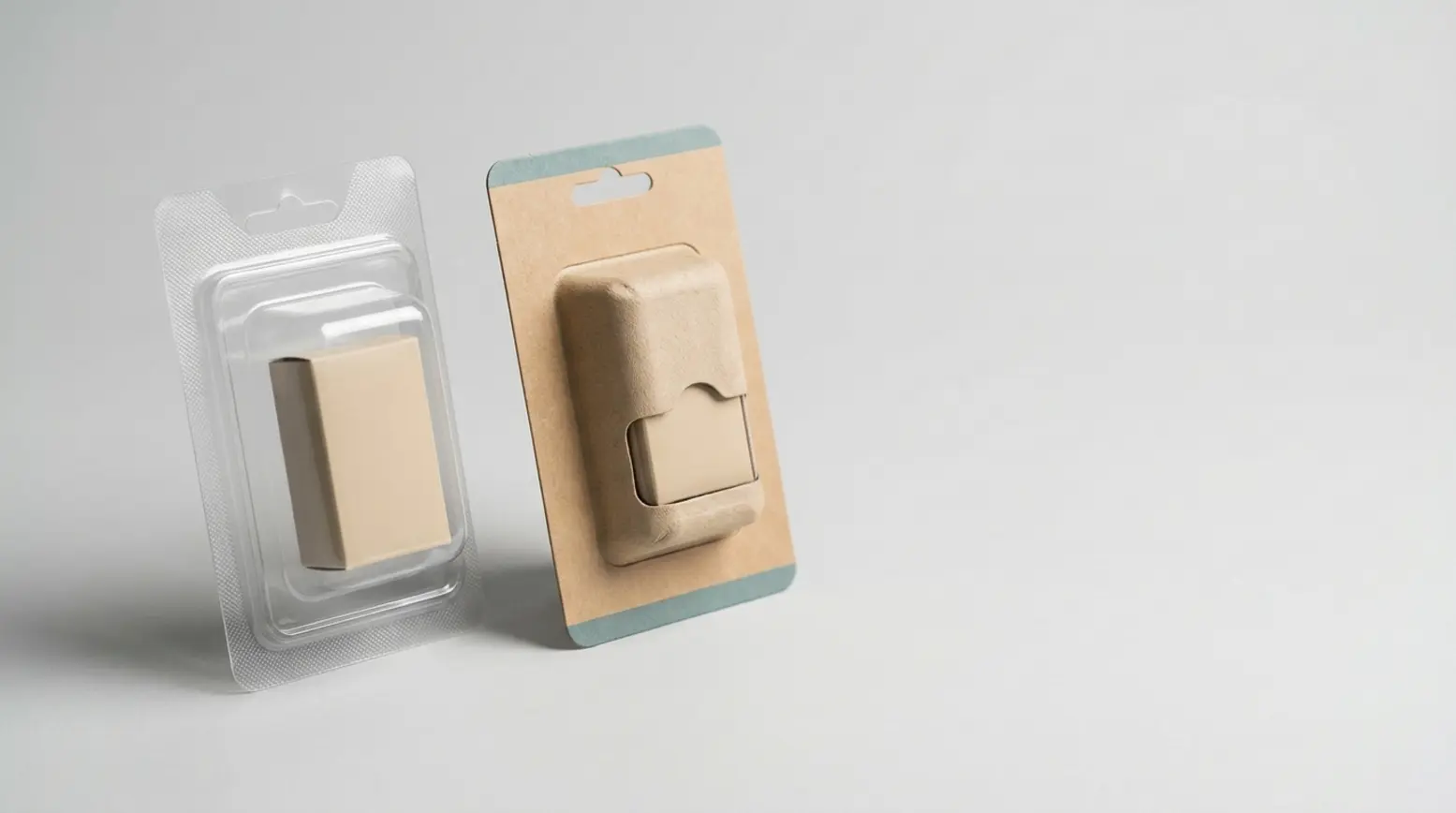

Paper and plastic blister packaging can both accomplish the same retail goals, but they do so in entirely different ways. Plastic typically excels when shoppers need a clear view of the actual product. Conversely, paper is usually the better option when print space, brand storytelling, and a paper-led aesthetic take precedence. Ultimately, the right choice depends on your SKU's specific needs regarding visibility, geometry, shelf messaging, packing performance, or a simplified material narrative.
This guide provides a direct comparison of blister packaging to help you make informed purchasing decisions. It evaluates both formats across visibility, protection, weight, material use, branding, end-of-life considerations, cost, and production impact. By exploring these factors, brand teams, engineers, and buyers can easily build a shortlist and determine what to test next.
• Plastic typically wins when a full product view drives the sale, as shoppers can closely inspect the shape, color, and fit.
• Paper generally prevails when graphics, claims, and shelf communication do the heavy lifting in sales.
• Geometry and handling demands often dictate the final choice, making a review of formed paper cups versus PET cups essential before switching materials.
• Cost should be evaluated across the complete pack and packing process, since raw material prices alone do not reflect the total value of the packaging.
• End-of-life outcomes depend on the packaging design and local recycling regulations, meaning broad environmental claims are rarely useful.
Paper blister vs. plastic blister: Start with the retail job to be done
Both paper and plastic blister packs aim to protect the product, hold it securely in place, present it attractively on the shelf, and support retail displays. They work well for both hanging and standing formats, supporting brand communication through direct product views, printed claims, or a combination of both. When considering a paper blister vs. plastic blister, the real question is which construction does that job better for your specific product. This article compares packaging structures to keep the focus on practical project decisions. If you want broader background information first, you can read our overview of types of plastic packaging before narrowing down your choices.
What stays the same in both formats
Both formats can adequately protect products while creating a clean retail presentation, and both can deliver strong shelf impact when the packaging is designed well. Furthermore, each requires reliable sealing and efficient packing, as excellent graphics or clear visibility alone will not overcome performance issues on the production line or during transport.
What changes when the material changes
The most significant differences lie in transparency, print area, forming behavior, and product reveal. Plastic provides broad visibility, whereas paper offers a larger surface area for graphics and instructions. The choice of paper packaging versus plastic also shifts what happens after use; depending on local recycling systems, some mixed packs might require consumers to separate the materials. Therefore, this goes far beyond a simple visual preference, as it also directly affects geometry, handling, and disposal steps.
| Criterion | Paper blister | Plastic blister | Verdict |
|---|---|---|---|
| Visibility | Selective reveal, cutouts, strong print support | Clear view of the real product | Plastic wins |
| Protection and geometry | Can work well, but has shape limits | Often better for deeper or more demanding shapes | Depends on geometry |
| Weight and material use | May reduce plastic use, but board design can grow | May use less board, but adds plastic content | Compare full pack |
| Print and shelf impact | More print space and a paper feel | Product view leads the presentation | Paper wins for graphics, plastic for product-hero packs |
| End of life | Can support a simpler, paper-led story | Depends on material choice and local systems | Depends on design and local rules |
| Cost | Driven by board, forming, print, tooling, and line impact | Driven by thermoforming, tooling, sealing, and line impact | Compare total pack value |
| Line and tooling | Usually needs redesign and trials when converting from PET | Established route for many retail blisters | Expect development work when switching |
Paper blister vs. plastic blister for product visibility
Plastic holds a clear advantage when it comes to broad product visibility. A transparent PET cup reveals more of the item from the front, and often from the sides as well, allowing shoppers to inspect the shape, color, and size before making a purchase. This is particularly important for cosmetics, electronic accessories, DIY products, office supplies, toys, and refill parts, where visual trust drives sales. In these scenarios, transparent plastic blister cups often remain the stronger retail tool.
Paper can still facilitate visibility through windows, cutouts, or a controlled reveal. In fact, paper blister visibility can be highly effective when the print and packaging design clearly explain the product. However, this is fundamentally different from full transparency. If the sale depends on seeing the actual item, deciding between a paper or PET blister is often an easy choice, as PET provides a much more direct view of the product.
When clear visibility matters most
Clear visibility matters most when shoppers compare products side by side and want to verify exact details. A specific lip balm shade, a charging cable connector, a small DIY part, or a stationery item frequently relies on visual confirmation. It is also crucial when the product itself is the primary reason to buy, as the shopper expects proof of quality before making a purchase.
Verdict
Plastic easily wins on broad product visibility. While paper can support a selective reveal, it simply cannot match a clear blister for providing a full view of the product.
Paper blister vs. plastic blister for protection and geometry
There is no universal winner in this category. Protection ultimately depends on the specific product, the packaging structure, and the handling demands across transport, retail shelves, and home use. Heavier items, sharp edges, deeper cavities, tight radii, or difficult shapes can quickly push a project toward plastic, as formed paper has different physical limitations. Consequently, the best answer typically starts with geometry and handling requirements rather than a general material preference.
Use after the purchase matters just as much. The opening feel and product access heavily depend on the package design, making it helpful to review easy-opening functionality early in the development phase. This keeps the discussion highly practical and helps avoid a material switch that might create usability problems down the line.
Questions to ask before changing material
Ask yourself whether the product is heavy, sharp, deep, or difficult to hold in place. Check if it features tight corners, undercuts, or strict close-fit requirements. Additionally, think about the potential for rough handling during logistics and store operations. If several of these points prove demanding, making a direct move to plastic-free packaging alternatives may be much harder than it initially appears. In such cases, the packaging must be carefully engineered around the product itself, not merely around a simplified material goal.
Verdict
Geometry and handling demands are the deciding factors. Neither paper nor plastic wins every project.
Paper blister vs. plastic blister for weight and material use
It is always better to compare complete packaging designs rather than assuming one route will consistently be lighter. Moving away from a PET cup certainly reduces plastic content, but the alternative paper pack may require a larger card, a thicker board, or extra layers to maintain stiffness and securely hold the product. Therefore, making a generalized statement about paper vs. plastic retail packaging can be misleading if the entire pack is not thoroughly reviewed.
This evaluation should remain SKU-specific. Factors like cup volume, board area, transport demands, and product protection all influence the final answer. Sustainable blister alternatives only make sense when the complete design continues to perform reliably in both retail and supply chain environments.
What to compare in the full pack
Compare the cup volume, board size, board thickness, added layers, stiffness requirements, and anticipated transport conditions. If the product is highly fragile or has an awkward shape, one manufacturing route might require more material to ensure stable performance. Because of this, the cost and weight of a paper blister should be verified through an actual design review rather than through mere assumption.
Verdict
Always compare the full design. Do not assume that paper or plastic will inherently be lighter or simpler.
Paper blister vs. plastic blister for print, branding, and shelf impact
Paper typically holds the advantage when graphics, marketing claims, and instructions require more space. It offers a broader print surface and a paper-led feel that beautifully supports a premium, natural, or information-rich presentation. This approach works exceedingly well for cosmetics, adhesives, hobby items, office products, and other packages where the message actively helps close the sale. If that route aligns with your product, exploring our all-paper packaging options is a highly practical next step.
Plastic often performs better when the real product is the hero on the shelf. If shoppers need to inspect the item directly, a crystal-clear presentation can easily outperform additional print area. This is especially common in color-critical, fit-critical, and comparison-led product categories. Therefore, choosing between a paper and plastic blister is often a direct choice between maximizing your communication surface and offering an unobstructed product view.
When paper often performs better on shelf
Paper often performs better when vivid graphics drive the purchase, when claims or instructions need ample room, or when the brand simply desires a paper-led look and feel. In these cases, the surface material itself does a significant portion of the selling work.
When plastic often performs better on shelf
Plastic frequently performs better when shoppers need to see the actual item clearly and compare it quickly. This includes scenarios requiring exact shape checks, visible quality cues, and products where the physical object itself is what builds consumer trust.
Verdict
Paper wins on available print surface and tactile brand communication. Meanwhile, plastic wins when a direct product view serves as your primary selling tool.
Recyclability and end-of-life in paper blister vs. plastic blister
This aspect requires a highly factual view. A paper-led package can create a simpler material narrative, especially when a traditional plastic cup is replaced entirely with paper. That simplicity can be highly useful for brands actively seeking sustainable blister alternatives. Still, there is no universal winner; end-of-life outcomes depend entirely on the exact construction and the local collection systems. If a package combines different material families, the user might need to separate the parts prior to recycling.
Both plastic blister recyclability and paper recovery depend on what the packaging is made from and what local recycling systems actively accept. It helps to ask a few simple questions: Is the pack made primarily from one material family? Does the user need to separate the parts? What exactly does the local waste management system accept? By asking these questions, your approach to sustainability remains practical and honest.
What the reader should assess
First, check whether the packaging consists of a single material family or a mixed-material format. Next, verify whether the consumer will need to separate the parts. Finally, research how local recycling systems actually handle those specific materials. Taking these steps is far more useful than making broad environmental claims, as they accurately reflect what happens after use in real life.
Verdict
Paper can easily support a simpler material story, but the true end-of-life outcome still depends heavily on the packaging design and local collection rules.
Cost and total pack value
Costs must be compared across the full package and the entire packing process. Examining the raw material price alone will not yield a fair answer, because board costs, forming, tooling, printing, sealing, labor, waste, and line speed all significantly impact the final result. Procurement teams typically find the clearest answers when they compare the final retail pack in real-world use, rather than relying solely on a material data sheet.
A lower material price can quickly lose its value if the production line slows down or if the product fit becomes less stable. Conversely, a higher unit cost can still make perfect sense if the package runs efficiently, supports the brand better, or reduces overall risk. Therefore, both paper blister costs and plastic pack costs should be judged based on total packaging value.
Cost drivers to compare
Review the board, cup forming or thermoforming, tooling, print, sealing, run lengths, packing labor, expected waste, and line efficiency. Even small design changes can affect multiple cost points simultaneously, making broad claims about one route consistently costing less highly unreliable.
Verdict
Compare the total value of the package, rather than focusing on the raw material price alone.
Line and tooling consequences
A formed paper cup is rarely a direct drop-in replacement for a PET cup. Forming depths, radii, tolerances, and fit behaviors all differ significantly, meaning a small redesign is usually more realistic than a simple one-to-one swap. Furthermore, sealing setups and packing routines may also change, which is why rigorous sampling and a comprehensive line trial are vital prior to launch.
This holds true for packaging engineers and production teams alike. Comparing a formed paper cup to a PET cup can reveal necessary changes to dimensions, cup shape, sealing settings, and how tightly the product sits within the pack. Even if the overall shelf footprint remains similar, the intricate production details may still shift. Thorough development work drastically reduces risk before final approval.
What usually changes in development
Packaging dimensions and cup shapes will likely change. Additionally, the sealing setup, tolerances, and packing routines may all require line adjustments. Because of this, any transition from PET to paper should be treated as a dedicated development project rather than a simple material switch.
Verdict
Expect to undertake redesign work, run samples, and conduct line trials when moving between these packaging constructions.
A practical choice guide for paper blister or PET blister
Choose paper when graphics do the majority of the selling work, when a paper-led material narrative matters, and when the product's shape naturally suits formed paper. Conversely, choose plastic when full visibility is central to the sale, when a deeper geometry is required, or when the overall shape and handling demands are higher. If the SKU sits somewhere between those two positions, it is wise to prototype both routes and compare them side by side.
Short decision test
• Choose paper when vivid graphics drive the sale, a paper-led material story matters, and the product's shape is well-suited for formed paper.
• Choose plastic when full visibility is absolutely central, deeper geometries are needed, and the shape or handling demands are significantly higher.
• Prototype both options when the SKU sits in the middle and both routes look viable on paper.
An excellent next step is to let your brand, engineering, and purchasing teams review the exact same physical package. You can request a sample to directly compare the transparency, print surface, stiffness, and opening feel before moving into product-specific trials.
Why a balanced supplier view matters
A fair comparison is much easier to achieve when the supplier deeply understands both routes. We work across cold-seal thermoformed blisters and all-paper packaging, allowing us to accurately assess trade-offs without forcing a single answer for every product. We also bring over 25 years of cold-seal experience, which is incredibly helpful when a transparent retail blister remains the better fit. If you are currently shortlisting suppliers, it pays to review product shapes, shelf goals, and production line needs together before testing your most realistic options.
Questions buyers ask about paper and plastic blister packaging
Is paper blister packaging always better for sustainability?
No. While paper can create a simpler, paper-led material story that proves highly useful in some projects, the real-world result depends entirely on the packaging design and local recycling systems. If the package utilizes more than one material, the consumer may still need to separate the parts prior to disposal.
Can a paper cup replace a PET cup without redesign?
No, in most cases, it cannot. Geometry, tolerances, sealing setups, and line routines frequently change when transitioning from plastic to paper. Implementing a small redesign, running samples, and conducting a line trial is usually the safest route to take.
Does paper always cost more than plastic?
No. A correct and accurate comparison must include the entire package and the entire packing process. Board costs, forming, tooling, print, sealing, labor, waste, and line efficiency all directly affect the final financial outcome.
When should a brand keep a transparent blister?
A brand should typically stick with a transparent blister when full product visibility serves as the primary selling tool. It also makes perfect sense when the product features deeper geometries, sharp details, or specialized handling demands that naturally push the packaging toward plastic.
For most teams, the choice becomes remarkably clearer once the trade-offs are reviewed in a highly structured way. Start by evaluating visibility, geometry, and shelf messaging. Then, check the end-of-life properties, costs, and line impacts. Following these steps yields a much stronger shortlist and provides a better first sample for a real, well-informed packaging decision.
Request a free sample now!


