


There is no universal answer when it comes to paper blister volumes and lead times for custom packaging. Because a custom-formed paper blister pack requires significant setup work before the first saleable pack is even produced, the reality depends on tooling, materials, artwork, production planning, packing, and transport. If you need a practical estimate, the best starting point involves your product size, the number of versions, artwork status, and launch timing.
• There is no single minimum order quantity (MOQ) for paper packaging or blister packs that fits every custom project.
• Fixed setup tasks, such as tooling and prepress, typically dictate the practical order level for a first run.
• Packaging lead times follow a chain of steps; therefore, delays early in the project can impact the final delivery schedule.
• An initial packaging production run generally requires more planning than a repeat order.
• Providing clear product details helps us determine whether a custom route, a shared format, or a stock option is the best fit.
Paper blister volumes and lead times: why there is no universal minimum
Many buyers look for a single number for minimum volume and another for timing. However, for custom-formed paper blister packs, such a simple answer is rarely helpful. Paper blister volumes and lead times depend on both fixed and variable work. Fixed work must occur before normal production can run smoothly, while variable work scales with volume. As a result, the practical answer varies from project to project.
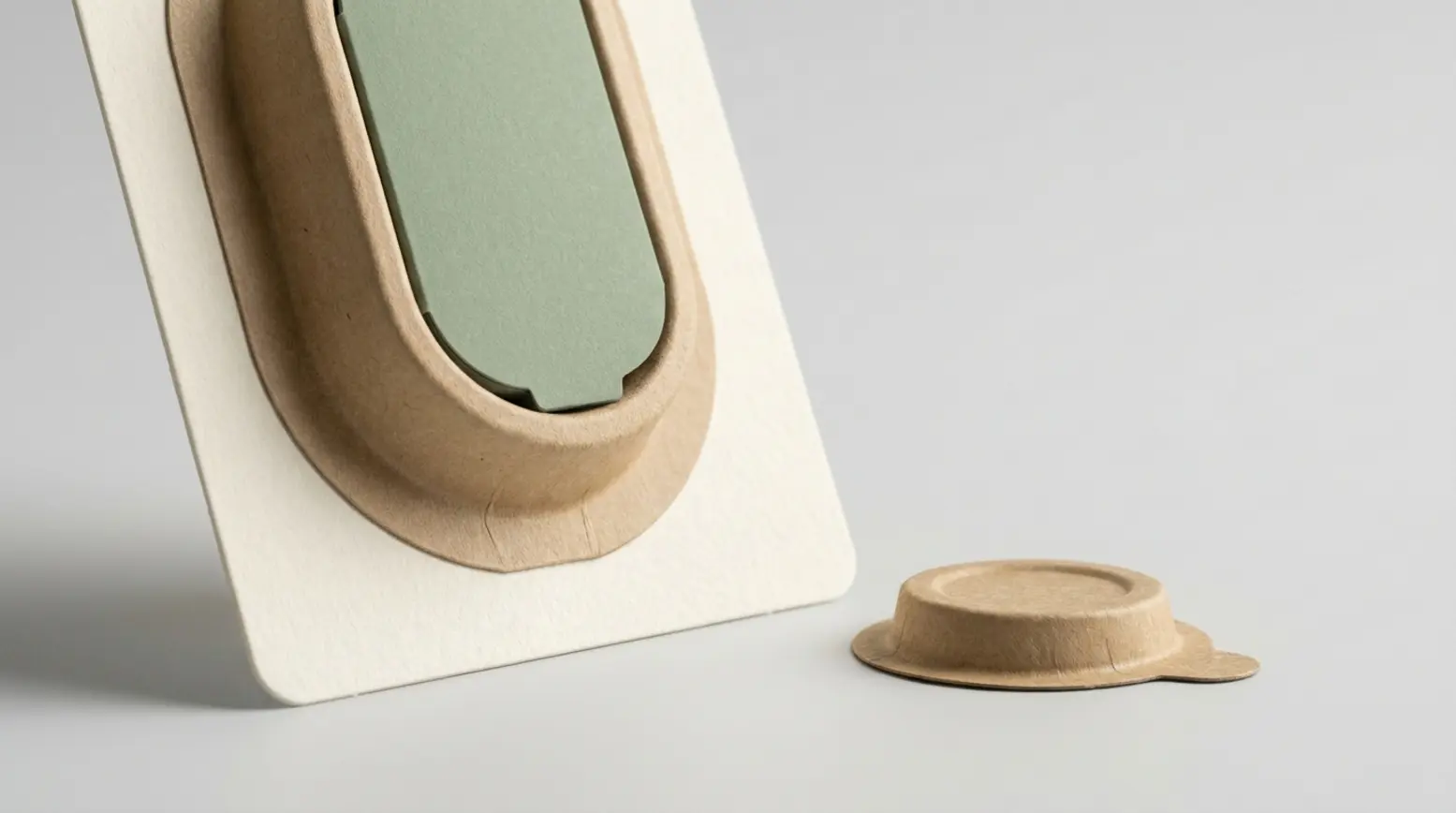
This article focuses on retail all-paper packaging, where a formed paper cup and a printed card must work seamlessly together. In this type of pack, the structure, print, materials, and final assembly are inherently linked. Consequently, relying on a single number can obscure essential planning steps.
What readers usually want to know
Procurement teams often ask about paper packaging minimum order quantities to help plan budgets and supply chains. Packaging engineers and product managers, on the other hand, want to understand the custom packaging timeline, as samples, approvals, and tooling lead times directly impact launch dates. Meanwhile, brand teams are eager to know whether multiple product versions can share dimensions or parts, allowing them to reduce custom setup requirements wherever possible.
Why a single number can mislead
A small project utilizing approved artwork and an existing format is vastly different from a brand-new pack featuring unique dimensions and a custom cup shape. Therefore, the same question can yield entirely different answers. A better approach is to ask: which steps create work before regular production can begin, and which of those steps are already completed for this project?
Paper blister volumes and lead times: what drives minimum order levels
The logic behind minimum order levels is straightforward. Certain tasks must happen regardless of whether the run is small or large, while other work scales with the total number of packs. This is why the minimum order for blister packaging is not solely about materials; it also relies heavily on setup, approvals, and the efficient use of production capacity.
Tooling comes first
A custom-formed cup requires a repeatable setup to ensure the part is manufactured identically every time. This is where tooling becomes essential. Because tooling generates work well before the first finished pack is ready for sale, it significantly impacts both cost and planning. In paper blister production planning, this is typically one of the main reasons why a very small run might be impractical.
Board purchasing and production formats
Paperboard is purchased and converted in large production formats, not one retail pack at a time. Consequently, material planning can impose practical order limits. The board type, sheet size, and conversion efficiency all play a critical role. This is another reason why a paper packaging MOQ cannot be reduced to a single, fixed threshold across every project.
Print preparation and packaging print run economics
While approved artwork is important, it does not mean the file is immediately ready for printing. Technical checks, file setup, and print planning still need to occur. You can learn more about this detailed step by visiting our guide on prepress for packaging. Because prepress and scheduling generate fixed amounts of work, the economics of a packaging print run can render very small custom orders inefficient.
Line changeover and capacity use
Production changeovers are equally important. A manufacturing line may require entirely different materials, tooling, artwork, or machine settings for a new job. This process takes time and consumes capacity, even if the final order is small. As a result, custom packaging setup must be factored in whenever teams inquire about minimum volumes.
| Project step | Why it affects minimum volume or lead time |
|---|---|
| Tooling | A custom-formed cup requires a repeatable setup before finished packs can be produced. |
| Board purchasing | Materials are planned in large production formats, making efficiency a key driver of practical order levels. |
| Print preparation | Artwork checks and file preparation create mandatory work before printing can even begin. |
| Line changeover | Switching materials and tooling takes time and consumes valuable production capacity. |
| Packing and transport | Finished goods still require final packing and delivery logistics before reaching the customer. |
Paper blister volumes and lead times: what shapes the lead time chain
Packaging lead times are much easier to understand when viewed as a complete chain. An initial project typically moves through design, sampling, tooling, material planning, prepress, print scheduling, component production, packing, and transport. Each stage depends on the successful completion of the one before it; therefore, an early change can cascade through the entire schedule. This is why paper blister volumes and lead times should always be discussed as a comprehensive process, rather than a single target date.
Design and sampling
Before series production begins, the packaging must fit the product perfectly and perform exactly as expected. The structure needs to protect the item while presenting it attractively in a retail environment. Furthermore, many projects require physical samples for review, which naturally takes time. In any custom packaging timeline, design and sampling must be planned early to facilitate smooth approvals later on.
Tooling manufacture for a first run
If the formed cup is entirely custom, specialized tooling must be manufactured before production planning can move forward. This critical step accounts for a significant portion of the packaging tooling lead time, which buyers might not initially anticipate. Because we produce our own components in-house, more of the process stays under one roof. Consequently, communication across design, component manufacturing, and final pack planning remains remarkably clear.
Material availability and planning
Materials must be readily available exactly when a job is scheduled to run. Even if the structure and artwork are fully approved, production will inevitably stall if the required paperboard or other key materials are missing. For this reason, sharing your expected demand and launch timing from the very beginning is incredibly useful, particularly when multiple product versions need to be coordinated.
Prepress and print scheduling
While artwork approval is a major milestone, it is certainly not the final hurdle before production. Files must still undergo a thorough technical review before being integrated into a print plan. Late artwork changes can severely disrupt the schedule, as prepress tasks and print planning will need to be completely revised. This explains why packaging lead times can shift, even after creative approval is secured.
Component production, packing, and transport
Once the design, tooling, materials, and print work are finalized, the project must undergo component production and final packing. After that, the finished goods require careful transport planning. Although this final logistical step is easy to overlook, it dictates the ultimate delivery path. For that reason, robust paper blister production planning considers the complete chain, from early design all the way to final shipment.
Paper blister volumes and lead times: why first and repeat runs are different
An initial packaging production run and a subsequent repeat order should never be treated as the same type of project. The first run typically involves far more checks, approvals, and setup work. In contrast, a repeat order can move much faster, provided the approved structure, tooling, and artwork remain unchanged. This fundamental difference helps explain why a single, fixed answer is rarely applicable.
First packaging production run
The initial packaging production run generally encompasses a structural review, sampling, potential tooling work, material planning, prepress, print scheduling, component production, packing, and transport. Since several of these intricate steps occur well before the first saleable packs exist, the first run invariably requires more setup. This is entirely normal for custom packaging and should be factored into your planning from the very beginning.
Repeat packaging order
A repeat packaging order typically progresses much more smoothly, as previously approved parts of the project remain consistent. If the structure is untouched and the existing tooling still fits, many of the earlier stages do not need to be repeated. This greatly simplifies planning for procurement teams and product managers, though the exact timeline still depends on precisely which elements remain unchanged.
What can restart earlier steps
Even minor artwork changes can trigger additional prepress work. Similarly, altered dimensions can impact the structure, board layout, or tooling requirements. Changes to the product's shape might also restart the sampling or engineering review processes, especially when a formed cup is involved. While having several SKUs share similar dimensions can simplify some tasks, the physical fit must always be verified against the actual product.
| Project type | What usually happens |
|---|---|
| First run | Involves design review, sampling, potential tooling, material planning, prepress, print scheduling, component production, packing, and transport. |
| Repeat run | Can reuse the approved structure and existing tooling, provided the product fit, dimensions, and artwork remain identical. |
Paper blister volumes and lead times: how to reduce complexity
While you cannot eliminate every step in a custom project, you can certainly reduce avoidable complexity. Minimizing complications aids in cost control, streamlines internal approvals, and improves supply planning. It also makes project discussions significantly easier, as a clearer scope results in a much more manageable custom packaging timeline.
Standardize card dimensions where possible
If your retail presentation permits, sharing card sizes across multiple items can significantly reduce custom work. This approach simplifies artwork planning and boosts overall production efficiency. Brand teams often benefit from this strategy, as the product range stays visually consistent and fewer packaging elements need adjustment.
Use a shared cup or tooling footprint across product versions
Whenever product variants allow, utilizing a shared component footprint can cut down on development work. Our section on paper blister cups illustrates the types of components that might influence this decision. However, this should always be treated as a design option rather than a guarantee, since every product fit requires a thorough engineering review.
Align artwork changes with planned reprints
Artwork updates are incredibly common, yet their timing is critical. By grouping changes with planned reprints, teams can avoid producing unnecessary intermediate versions. In doing so, prepress and print scheduling can proceed with far fewer disruptions, ultimately supporting better economics for your packaging print runs.
Consider a stock route when custom work is not justified
Sometimes, a fully custom route simply is not the best fit. If your launch timing is unusually tight or early demand remains uncertain, exploring stock blisters might be worthwhile. If an existing format already suits the product perfectly, your project will require far less development work before entering production.
• Standardize card dimensions wherever possible, making artwork and production planning simpler across multiple SKUs.
• Review whether compatible product versions can share a cup footprint, provided engineering checks confirm a proper fit.
• Align any artwork changes with planned reprints to minimize extra prepress steps.
• Compare the custom route against stock blister options when rapid speed or uncertain demand makes fully custom work harder to justify.
Questions to take into your project discussion
The best way to get a useful answer is to provide real project details. This helps turn a broad question about paper blister volumes and lead times into highly practical guidance regarding the volume, timing, and the most suitable route for your specific packaging.
Useful details to prepare
Be sure to provide the product's dimensions, shape, weight, and any special fit requirements. Additionally, include your expected demand, the number of product versions, current artwork status, and target launch timing. It is also immensely helpful to clarify which components must be custom-made and which can remain standardized across variants. Equipped with this information, project discussions become highly specific and much more productive.
When to contact us
If you already have clear specifications, we can offer much better guidance than any generalized threshold could provide. We can also evaluate whether a custom route, a shared component approach, or a stock option makes the most sense for your specific needs. When you are ready, please contact us with your dimensions and timing so we can discuss the entire planning chain in the appropriate level of detail.
FAQ
Why is there no fixed paper packaging minimum order for every project?
There is no single fixed answer because custom-formed paper blister packs involve numerous setup steps well before normal production can begin. Tooling, board planning, artwork preparation, line changeovers, packing, and transport logistics all influence the final requirement. Ultimately, a useful answer relies heavily on your actual packaging design and specific launch plan.
What changes between a first packaging production run and a repeat packaging order?
The first run typically involves intensive design work, physical samples, custom tooling, and initial approvals. A repeat packaging order, however, can often reuse the approved structure and existing tooling, provided nothing significant has changed. Naturally, if the product, its dimensions, or the artwork are modified, some of those earlier setup steps will need to be repeated.
Can several product versions share one paper blister format?
Sometimes they can, but not always. While shared card sizes or a common cup footprint can effectively reduce setup work, the physical fit must still be examined carefully. Therefore, shared formats should always be reviewed on a case-by-case basis.
When is a stock blister route worth considering?
A stock route is highly useful when custom development is difficult to justify due to low expected volumes or tight launch timing. It is also a great option when an existing size already accommodates your product perfectly. In such cases, the project will require far less custom work before production can commence.
Request a free sample now!


