


The Packaging and Packaging Waste Regulation (PPWR) dictates that DIY and hardware packaging should utilize only the minimum amount of material necessary. In practice, achieving PPWR for DIY and hardware packaging is primarily a design task, as many items are heavy, sharp, small, valuable, or difficult to hang securely on a retail hook. The best approach is typically to reduce the overall pack size, review its structural integrity, compare different formats, and then select the most suitable material to ensure optimal protection, visibility, hanging performance, and theft resistance.
• Start with right-sizing, as a smaller pack often reduces material usage without compromising functionality.
• Maintain necessary packaging functionality, because heavy or sharp products still require adequate protection and strong hanging support.
• Compare formats before selecting materials, allowing you to determine whether a compact blister, trapped blister, or paper component best suits the actual product.
• Opt for paper where it works well, especially for lighter items that do not require full transparency or strong restraint.
• Test real products within realistic pack concepts, as factors like weight, sharp edges, transport loads, and in-store handling can significantly influence the best choice.
Why PPWR for DIY and hardware packaging is not a simple paper versus plastic choice
Although the PPWR creates pressure to reduce packaging, this does not eliminate the need for essential functionality. In the DIY and hardware packaging retail sectors, many products exert significant stress on concentrated areas of a package. Some items are incredibly dense, others have sharp edges, and certain products are highly susceptible to theft. Because of these factors, addressing PPWR in DIY and hardware packaging should not begin with a basic material debate. Instead, the process must start with the actual product, the retail environment, and the physical load the pack must endure. We see this dynamic clearly in DIY packaging for retail products, where the package must protect the item, display it effectively, and perform reliably on the shelf all at once.
What makes DIY and hardware products different
DIY and hardware packaging covers a broad range of product types, from small screws and drill bits to heavy metal parts and accessories. While a lightweight item might require only minimal support, a heavy or awkwardly shaped product can pull forward on the hanger area, creating intense stress during transport and retail display. This is a critical factor in hanging retail packaging, as a simple front view rarely reveals the true forces acting upon the pack. Consequently, a hardware blister pack often remains the preferred choice because it maintains its shape exceptionally well and keeps the product highly visible to the shopper.
Why necessary packaging function still matters
While reducing packaging is highly important, a failed pack ultimately creates waste as well. If an item breaks its package, falls off the retail hook, or becomes too easily opened in the store, the design is no longer fulfilling its primary purpose. Therefore, evaluating PPWR hardware packaging requires a balanced review. The underlying question is simple: what exact construction and material does the product genuinely need to move safely through packing, transport, shelf display, and final purchase?
Retail pressures that shape PPWR in DIY and hardware packaging decisions
Retail packs for hardware do much more than simply carry a product. They must fit specific store fixtures, help shoppers quickly identify the item, support brand graphics, and often restrict easy access while in the aisle. These complex needs directly influence tool packaging blister design from the very beginning. A successful pack should work seamlessly in the hand, on the shelf, and hanging on a hook, since hardware retail packaging depends on both appealing display and rugged functionality.
Hanging presentation and retail hook performance
Because many DIY products are sold hanging on hooks, retail hook packaging must be reviewed with meticulous care. Card strength, hanger hole positioning, product depth, and overall weight distribution all significantly impact how the pack behaves in a store. If the product sits too low or leans too far forward, the hanger area can easily bend or tear. Therefore, the pack’s front layout, side profile, and hanging angle should be evaluated together during the initial design stage.
Theft risk and in-store access
Many hardware items are small, highly useful, and easy to conceal, meaning theft risk can completely alter the ideal format. For theft-resistant packaging in DIY projects, security parameters should be introduced into the brief early on, as they heavily influence both structure and material choices. Our theft-secure packaging functionality demonstrates how these protective measures can be integrated into the design process from the start. A pack that uses less material may ultimately be the wrong solution if it opens too easily within the store environment.
Multipacks and concentrated product weight
Multipacks present an entirely different challenge, as several individual parts can exert a strong, combined force onto one small area of the package. Consequently, material reduction must be approached carefully. While a small material saving per pack is significant at scale, a concentrated product weight may still mandate a structurally stronger format. As a result, the most effective packaging choices are often driven by structure first and material second, ensuring that both cost and performance remain balanced.
How to improve PPWR for DIY and hardware packaging in the right order
The most practical approach to improving PPWR in DIY and hardware packaging is to follow a clear, systematic order. First, eliminate empty space and review the overall dimensions of the card. Next, check whether the formed area can be made smaller or shaped more efficiently. After that, compare various blister types and question whether a full clamshell is truly necessary. This methodical process helps teams confidently cut unnecessary material without relying on guesswork.
Start with right-sizing the pack
Right-sizing is often the fastest way to achieve meaningful gains. Carefully review the blister depth, card dimensions, hanger area, and the empty space surrounding the product. A smaller pack not only reduces material consumption but also improves shelf density simultaneously. Furthermore, a streamlined design makes the package easier for retail staff and shoppers to handle in-store. For many products, this is the strongest initial step in any recyclable tool packaging initiative, as it significantly reduces material usage while maintaining the same basic packaging format.
Reduce the formed area where possible
After right-sizing, examine the formed portion of the pack closely. Sometimes, a product can be held securely in place by utilizing a tighter shape, a different orientation, or a more robust backing card. When these adjustments are made, the blister can be downsized without sacrificing performance. We specifically design cold seal blister packaging to facilitate this type of structural optimization, especially in cases where visibility, secure enclosure, and practical retail functionality remain top priorities.
Consider a trapped or carded blister before a full clamshell
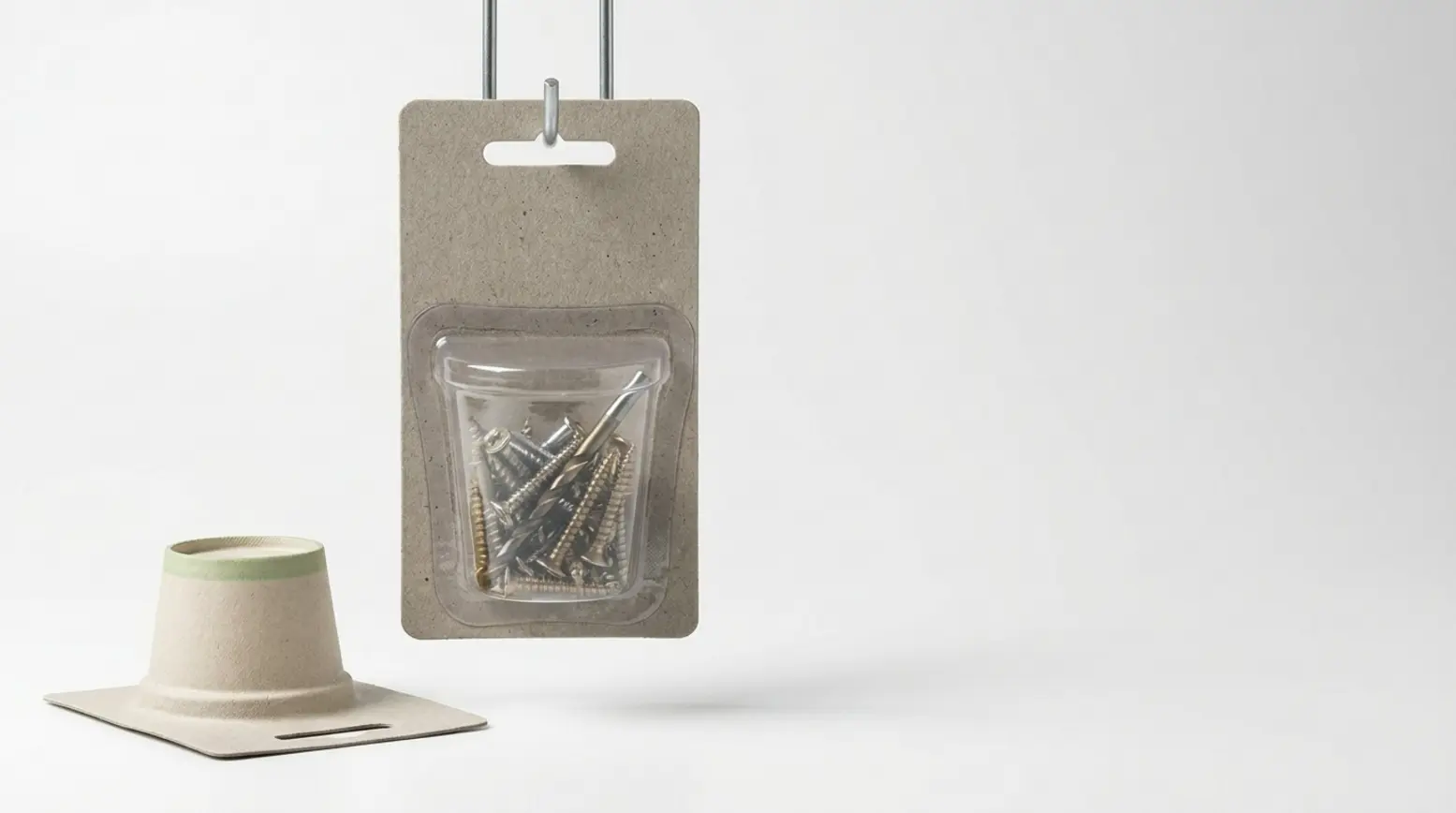
While a full clamshell can be beneficial for specific products, it is rarely absolutely necessary. If the item does not require full plastic enclosure, a trapped blister or a standard carded blister can often perform the exact same retail job while consuming far less material. This is frequently a smart approach for tool packaging blister projects where product visibility and hanging strength remain important, yet a larger plastic shell simply adds more bulk than the product actually requires.
When PPWR for DIY and hardware packaging can move to paper components
Paper-based options can be an excellent route, provided the product's attributes allow for it. Under PPWR for DIY and hardware packaging, formed paper cups or trays are frequently worth testing for lighter items and small accessories that do not require full transparency or rigid restraint in one specific area. This is precisely where paper blister hardware concepts can support a more paper-dominant pack structure; however, the product itself still requires an honest, thorough review before final approval.
Good candidates for formed paper cups or trays
Lighter accessories, parts with smoother edges, and products featuring simpler shapes are generally ideal candidates for paper components. These items are typically easy for consumers to identify without needing a fully transparent front, and they tend to place far less physical stress on the formed portion of the pack. Our paper blister cups replace the traditional PET blister cup with a molded paper alternative. By keeping many familiar pack features intact, this allows design teams to directly compare a realistic paper-based route alongside their current packaging format.
Where paper loses ground to visibility or strength needs
Conversely, paper may be less suitable when a product requires a deeply formed cavity, unobstructed full visibility, or firm restraint focused in a single area. A dense metal item hanging on a retail hook is a prime example of this limitation, as the concentrated load can severely stress a paper pack during transport and prolonged display. Therefore, the choice of material should always follow the actual needs of the product. In many cases, a compact plastic blister remains a superior engineering solution compared to a bulky paper structure that consumes more total material while providing significantly less control.
Testing limits in PPWR for DIY and hardware packaging for heavy or awkward products
Difficult products tend to expose the structural limits of a packaging redesign very quickly. When optimizing PPWR for DIY and hardware packaging, it is crucial to remember that a heavy item hanging on a hook can pull downward, lean forward, and shift dynamically during transport. Consequently, the package must be engineered to resist multiple types of competing forces simultaneously. Thorough physical testing is absolutely essential, as digital drawings and theoretical assumptions can never fully predict how a pack will actually behave in a retail setting.
Why a heavy hanging product changes the design choice
A lightweight accessory and a dense metal product might appear remarkably similar on a display shelf, but they behave entirely differently once enclosed in a package. Factors such as localized weight concentration, sharp geometric edges, and hanging angles can completely alter the optimal design path. This is precisely why specific hardware blister pack concepts consistently remain the most appropriate fit. If the product fundamentally requires rigidity, transparent visibility, and strict shape control, a smaller, well-designed plastic blister will often outperform a weaker material alternative.
What must be tested before approval
Before any final approval, teams must test the actual product inside the physical packaging concept. It is critical to meticulously review the weight distribution, precise dimensions, edge conditions, hanging geometry, expected transport loads, consumer opening behavior, and the effects of repeated shelf handling. Additionally, evaluators should observe how the package looks and feels after normal in-store consumer contact. We strongly advise conducting product-specific testing, as both paper blister hardware solutions and compact plastic blister designs can behave in vastly different ways once the physical item is secured inside.
Security and shelf impact in PPWR for DIY and hardware packaging
Security and presentation requirements should be explicitly outlined in the initial brief, as late-stage modifications frequently result in wasted time and resources. If a product carries a high risk of theft, the packaging structure may demand tighter control around the opening mechanism or a more robust overall enclosure. Concurrently, the final design must continue to support high shelf visibility and ensure the efficient use of retail fixture space. This is exactly why implementing PPWR for DIY and hardware packaging requires active, collaborative input from engineering, retail, branding, and procurement teams right from the start.
Build theft resistance into the pack design
A robust enclosure is completely justified whenever an easily opened pack creates a significant in-store security risk. While security tags may prove helpful in certain scenarios, they cannot serve as a replacement for a package that is structurally tailored to both the product and the retail aisle. The best approach is to define the specific access risk first, and then deliberately choose a packaging format that thoroughly mitigates that risk while simultaneously supporting excellent visual presentation and easy handling.
Balance visibility, access, and shelf efficiency
Shoppers naturally want to understand a product quickly, meaning high visibility and clear graphics are vital for sales. Simultaneously, retail teams require packs that hang perfectly and utilize premium shelf space efficiently, while procurement teams demand a structural design that can be confidently tested, sourced, and reviewed. A truly successful packaging format brings all these diverse needs together in a highly practical way, ensuring the final result works flawlessly for both the product and the store environment.
A practical comparison for pack choice
Design teams often need a simplified way to compare different packaging options before moving into the expensive prototyping phase. The points below provide a practical, high-level starting view. While they certainly do not replace the need for physical testing, they help illustrate where each structural route may be most appropriate.
• Compact cold seal blister: This is often the superior fit when a product demands clear visibility, strict shape control, a highly secure enclosure, or reinforced hanging support. This particular route is well-suited for a hardware blister pack that features concentrated weight in one specific area or an otherwise awkward profile. Our unique cold seal format utilizes highly recycled cardboard paired with a water-based, solvent-free adhesive, allowing it to seamlessly support material sustainability improvements while keeping all key packaging functions intact.
• Formed paper cup or tray: This structural option is frequently the better fit when the item is lighter, easier to contain, and far less dependent on full frontal transparency. This paper-based route can work remarkably well for selected hardware accessories and simpler components. However, the pack still requires a comprehensive, product-specific review to evaluate edge conditions, potential transport risks, and maximum hanging loads.
Example: when a compact blister remains the better fit
Consider a dense metal fixing set destined to be sold on a standard retail hook. The prospective shopper needs to see the product clearly, the package itself must support heavily concentrated weight, and preventing easy, unauthorized in-store access might be a major concern. In such a scenario, a right-sized, reduced cold seal blister typically proves to be the much smarter redesign. The true sustainability gain here comes from utilizing only the exact physical structure the product demands, rather than forcing a transition to a significantly bulkier alternative format.
Example: when a paper component is worth prototyping
Now, picture a much lighter DIY accessory featuring smooth edges and a substantially lower need for full product visibility. A formed paper cup may provide more than enough support while successfully transitioning the package toward a more sustainable, paper-based structure. This route is highly worthwhile to test, as the final result will always depend on the specific product and the intended retail setup. If you wish to physically compare both structural options in hand, you can easily request a sample to carefully evaluate fit, presentation, and overall construction prior to conducting deeper testing.
FAQ
Can PPWR still allow plastic in hardware packaging? Yes. Plastic can absolutely still be necessary when the product fundamentally requires stiffness, clear visibility, a highly secure enclosure, or a very precisely formed shape. The ultimate aim is to reduce and fully optimize the pack first, and then retain only the specific material needed to perform the required job effectively.
When is a paper blister cup a realistic option? A paper blister cup is frequently a realistic and effective option for lightweight products and simple accessories that do not demand full frontal transparency or immense holding force. Minimalist product shapes and lower retail hanging loads also tend to make paper components significantly more suitable. Nonetheless, the actual product still requires rigorous physical testing before any final structural approval.
How should heavy products on retail hooks be tested? Always test the actual, physical product securely enclosed within the intended packaging concept. Meticulously review its weight distribution, overall shape, edge conditions, hanging geometry, anticipated transport loads, consumer opening behavior, and resilience to repeated shelf handling. This hands-on process consistently yields a far more reliable answer than simply reviewing two-dimensional digital drawings.
Does theft risk change the best packaging format? Yes. If transitioning to a lighter or simpler structure makes the product far too easy to access in-store, returning to a more robust, secure format may be entirely justified. Retail security considerations should be integrated into the packaging brief as early as possible, as they will directly dictate structure, material choices, and ultimate retail performance.
Request a free sample now!


