

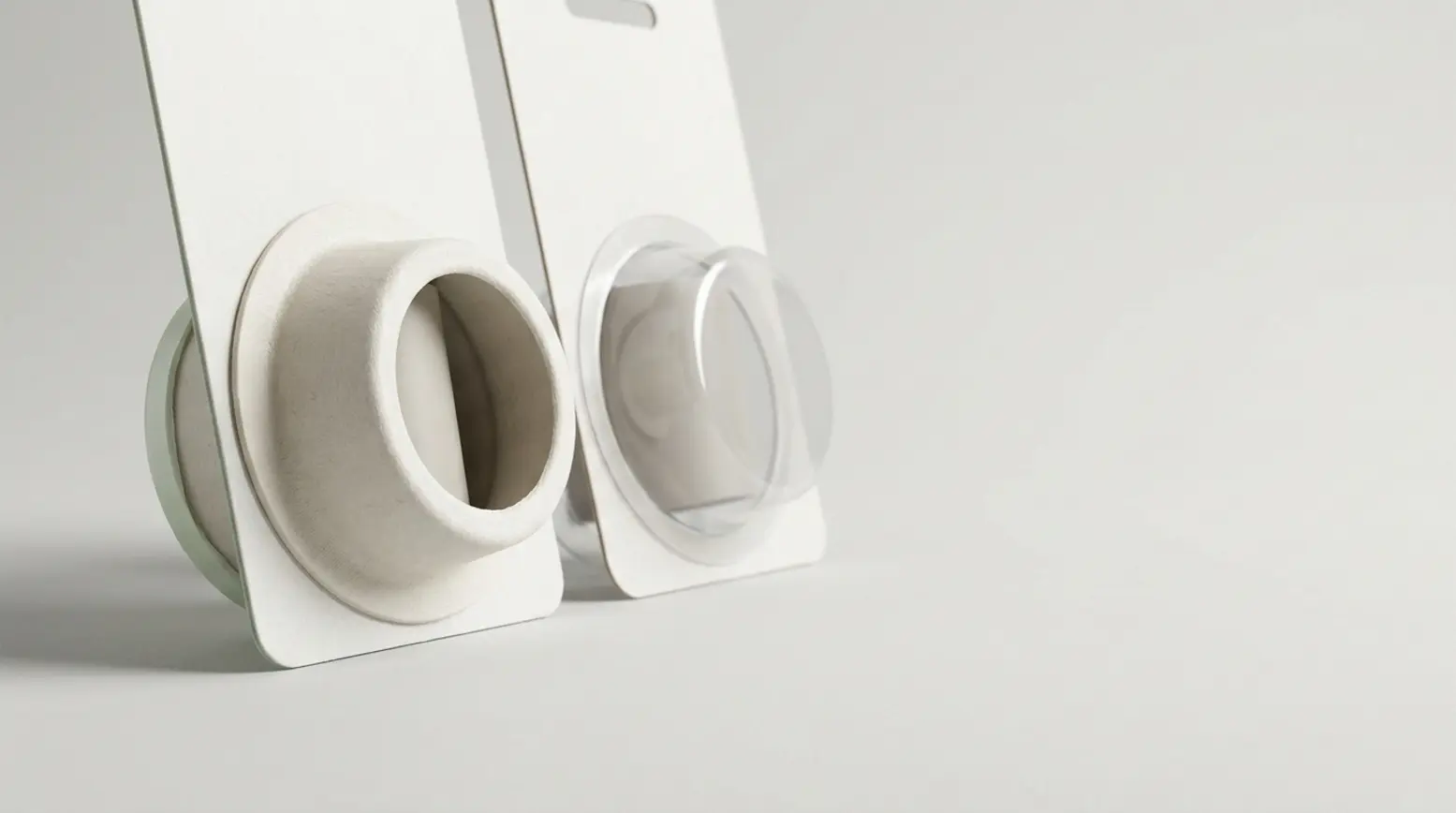

Replacing a PET blister cup with paper usually involves changing more than just one material. It can affect pack shape, sealing methods, tooling, feeding, inspection, storage, and transport checks. Therefore, switching from a PET to a paper blister should be planned as a comprehensive packaging conversion project. This ensures the product, pack design, and production line are reviewed together before full production begins.
• A paper cup is rarely a direct replacement for a PET blister because the shape, flange, depth, and stiffness typically change.
• Tooling, sealing, and handling points should be checked early, prior to making a final investment in production parts.
• A paper blister line trial must include target speeds, realistic changeovers, and clear approval criteria.
• Quality control often shifts because paper components behave differently, and the clear cup is no longer available for the same type of visual inspection.
• Transport and shelf checks are crucial because a pack might pass on the line but still shift or alter later during handling or shipment.
Switching from a PET to a paper blister starts with a conversion project
If you are planning on switching from a PET to a paper blister, treat it as a full conversion project from the start. Moving from plastic to paper packaging often reaches far beyond simple sourcing since the new cup can alter geometry, sealing, handling, and the overall user experience. While some parts of the current setup may remain useful, their reuse can only be confirmed once the new pack construction is defined and tested on the intended line.
Why a paper cup is not a direct PET replacement
Even if a paper cup holds the same product as a PET cup, it might still require a different shape. The flange, wall angle, depth, or edge profile may all change. Consequently, old blister tooling should never be assumed to match the new paper format. This is a primary reason why teams looking to replace PET blisters need an early technical review.
When to redesign the pack as a system
It is best to redesign the pack as a single system when the material, sealing route, handling path, and opening experience all change together. This often happens when switching from a PET to a paper blister, especially if a brand is also looking at switching to all-paper packaging. Since different products and pack formats convert in unique ways, the entire pack should be carefully reviewed before making any final decisions on materials or tooling.
Switching from a PET to a paper blister means checking tooling first
Tooling is often the first technical checkpoint because many machine parts rely on the old cup shape and pack outline. Some tools support geometry, while others support sealing or guide the pack along the machine path. A successful paper packaging conversion evaluates these groups separately, allowing the team to identify what can stay, what needs to change, and what must be proven during a trial.
Geometry tooling
Geometry tooling relates to cup shape, flange width, depth, and the outline of the finished pack. Even when the product remains the same, a paper cup may require a different profile for stability or sealing. Therefore, new format parts are often needed for the updated construction. This is a common hurdle in PET blister replacement projects.
Sealing tooling
Sealing tools depend on the chosen pack build. If the sealing route changes, the sealing area and pressure pattern are likely to change as well. This means sealing tooling should only be reviewed after the new architecture is fully defined. In practice, paper blister sealing is closely linked to materials, machine setup, and pack layout, so all these choices must remain aligned.
Handling and format tooling
Guides, nests, pick points, and transfer points can all depend on pack shape and stiffness. Paper parts frequently move through the line differently than PET parts because their surface feel and structural behavior contrast. As a result, handling tooling and format parts may require modifications even when the pack initially looks similar.
Confirm dimensions before final tooling investment
Before ordering final production tooling, confirm the new format dimensions and handling points with samples or trial parts. Check how the cup sits, how the card aligns, and how the pack travels through the machine. Early confirmation helps prevent expensive changes later and provides operations and procurement teams with a stronger basis for approval.
Switching from a PET to a paper blister changes the sealing setup
Sealing is a major factor when switching from a PET to a paper blister because the pack design can shift in more than one way. There is no single standard route for paper blister packs. The chosen sealing method directly affects materials, card specifications, tooling, and the sealing station setup. Therefore, the choice of sealing should be integrated into the design decision right from the start.
Cold seal construction with paper layers
One route uses pressure to hold the paper cup between paper layers. This is known as a cold seal construction. It differs from direct heat sealing to a card because it relies on pressure and material compatibility rather than heat at the sealing point. Having invented cold seal technology with over 25 years of experience in the field, our work with cold sealing proves that process settings must precisely match the exact materials and line conditions used for the project.
Heat seal construction directly to the card
Another route attaches the paper cup directly to a card using heat sealing. This method may require a different card type and an altered sealing station setup. Because of this, the sealing route is not a detail to be left for the final stages. It is a fundamental part of the pack architecture and should be defined early in the project.
Why sealing affects pack architecture
The sealing method can influence the card structure, sealing area, machine movement, and finished pack layout. In this way, sealing naturally connects design with production. When teams review paper blister sealing early, they can make clearer decisions regarding pack performance, line setup, and inspection needs.
Do not assume standard settings
Never assume that standard temperatures, pressures, or dwell times will seamlessly work for a paper packaging conversion. These settings must be carefully developed for the specific materials, equipment, and pack design chosen. A line trial is the ideal setting to confirm what actually works on the real paper blister production line, as stable output relies on the complete system working in harmony.
Switching from a PET to a paper blister affects line speed and changeovers
Line speed and packaging changeovers should be treated as project variables. Paper is not inherently faster, nor is it always slower. Stable output depends heavily on feeding, alignment, cup placement, card handling, and sealing quality at the targeted production rate. Thus, any assumptions about performance must be tested on the intended equipment.
Stability at the target production rate
The ultimate goal is a stable process at the planned output level. This encompasses repeatable feeding, accurate placement, and consistent sealing across the entire run. If a single step becomes unstable, the full line can suffer. Therefore, the trial should reflect normal production conditions as closely as possible.
Include real changeovers in the trial
If multiple SKUs or pack formats use the same equipment, incorporate realistic format changes during the trial. A comprehensive paper blister line trial should reveal what happens during setup, restart, and the switch between runs. Some issues only appear during these transition periods, making this step incredibly important for engineering and operations teams.
Set approval criteria before the trial
Agree on the approval criteria before the trial begins. Clearly define what counts as acceptable setup time, restart quality, and output stability. This establishes a shared foundation for procurement, operations, and brand teams to make a final decision, reducing confusion when results are reviewed later.
Switching from a PET to a paper blister also changes handling and quality checks
Handling, storage, and inspection procedures often change more than teams anticipate. Because paper parts behave differently than PET parts, both the line setup and the quality plan need a thorough review. Many issues only surface under normal production conditions, which is why this phase of the project should not be postponed until after the tooling is completed.
Paper components behave differently on the line
Paper components can react differently to friction, machine contact, and the route taken through the equipment. They can also respond uniquely to storage conditions over time. Due to this, handling points that worked well for PET may require adjustment for the new paper format.
Storage and conditioning belong in the specification
Paper component storage should be detailed in the production specifications, not just noted in a warehouse log. The same applies to conditioning before use on the line. Always follow the component and equipment specifications developed for the project, as general paper storage rules are rarely sufficient for every format or production environment.
Quality checks that may change
When teams replace PET blisters with paper, quality checks often need updating. Review cup shape consistency, card condition, alignment, seal integrity, print condition, and finished pack appearance. These checks help ensure that the new pack works as planned and remains stable throughout production and handling.
Visual inspection can change
Once the clear cup is removed, operators may no longer see the product or seal area in the same way. This can impact both manual and camera inspections. As a result, the inspection plan must be reviewed early on, because the line may require entirely different control points once the transparent component is gone.
Consumer use may need a new review
The opening experience can shift when pack structure, seals, and card designs change. This presents a great opportunity to review how a user opens the pack and what they need to see first. If optimizing the pack's opening is part of the project scope, our easy-opening design page explains how this function can be seamlessly integrated into the packaging.
Project sequence from sample to full production
A clear project sequence reduces risk because it keeps decisions in the correct order. It also helps teams stay focused on the complete pack rather than just one material choice. We suggest following a simple path from the early concept stage straight through to full production approval.
• Confirm the product, current pack, target volumes, and line setup before design work even begins.
• Create early samples to review the fit, look, and basic handling of the new format.
• Confirm geometry, including cup shape, flange, card size, and key handling points, before final tooling is ordered.
• Perform a line trial under realistic operating conditions, taking into account the target speed and any relevant packaging changeover steps.
• Check the finished pack after packing to assess seal integrity, alignment, print, appearance, and basic pack function.
• Run a transport evaluation before full volume transfer, ensuring the new pack is approved under realistic handling and shipment conditions.
At this stage, be sure to bring your current pack, product dimensions, target volumes, and line setup into the discussion. If you want to contact us about your conversion project, we can review the specification work with the full pack in mind and practically support your next steps.
What to test after packing, handling, and transport
The finished pack should be evaluated after packing and realistic distribution, not only at the sealing station. A pack can appear correct on the line yet still shift later during handling, storage, or shipment. Therefore, final approval should involve comprehensive checks on the finished pack after the product leaves the machine.
| Project area | What may change | What to check before full run |
|---|---|---|
| Cup geometry | Shape, depth, flange, outline | Fit to product, pack alignment, tooling match |
| Sealing method | Cold seal route or heat seal route | Material compatibility, seal area, station setup |
| Tooling | Geometry, sealing, handling parts | Reuse potential, final dimensions, support points |
| Feeding and alignment | Movement through the machine | Stable placement at target rate |
| Changeovers | Setup and restart behavior | Format switch time, restart quality, output stability |
| Storage and conditioning | Material behavior before use | Specification compliance, line readiness |
| Quality checks | Inspection points and acceptance criteria | Shape, seal integrity, print, appearance |
| Transport test | Pack behavior after distribution | Protection, appearance, shelf readiness |
Shelf behavior and appearance
Check whether the pack continues to protect the product and present it well on the shelf. Review the alignment, print quality, surface condition, and overall appearance after handling. This aligns operations and brand teams, allowing them to approve the final pack with clear, shared expectations.
Transport testing before volume transfer
If the construction changes in a significant way, run a representative transport test before moving to full volume. The aim is to confirm the pack's behavior after normal handling and shipment. By doing this, the decision to move forward is based on tangible proof from the finished pack, not solely from the production line.
Why teams still choose paper blister packs
There are certainly sound reasons to move forward with paper, but the benefits must remain linked to the actual pack design chosen for the project. This ensures that teams make balanced decisions and avoid broad claims that do not accurately fit the final construction.
Simpler material story
Replacing the PET cup with paper can simplify the overall material story of the pack. For some brands, this supports a clearer packaging direction as they move toward all-paper packaging. However, the final messaging should always reflect the actual materials and structures used in production.
More printable surface
While a paper cup removes transparency, it creates significantly more printable space. This is highly advantageous for branding, instructions, warnings, or product details. It is particularly useful when the pack needs to carry additional information without incorporating extra parts.
Sustainability should stay factual
We believe in keeping sustainability practical because any claims should accurately follow the real pack build. Paper-based constructions, recycled cardboard, recycled PET where relevant, and water-based adhesives in cold seal packs are all excellent examples of material choices that support a factual message. Ultimately, the right statement depends entirely on the final specifications, meaning general claims should always be avoided.
FAQ about PET to paper blister conversions
Can we reuse our current PET blister tooling? Occasionally, certain parts may still be useful. However, reuse should never be assumed before the new paper construction is strictly defined and key dimensions are confirmed.
Will paper run faster or slower than PET? It largely depends on the complete pack design, handling route, sealing method, and target speed. This must be proven during a real line trial.
Do we need new quality checks? In most cases, yes. Shape consistency, card condition, alignment, seal integrity, print quality, and finished pack appearance all typically require a thorough review.
Does paper change the consumer experience? It certainly can. The pack may open differently, and product visibility naturally changes because the clear plastic cup is no longer present.
What should we bring into a conversion discussion? Bring the current pack, product dimensions, target volumes, and line setup. These elements help properly define the project scope early on.
Start the specification work with the full pack in view
A successful conversion heavily depends on seeing the full picture early. This includes design, components, primary and secondary packaging support, and production realities. Because we provide complete retail packaging from a single supplier, we can support your pack design, component production, and broader implementation needs. If the complete setup requires further review, our packaging automation guide can help you effectively think through equipment and implementation as a cohesive part of the full project.
Request a free sample now!


