


Eco-modulation changes the EPR fee a producer pays after packaging is placed on the market, as the fee can reflect design choices alongside weight or volume. In practice, eco-modulation EPR fees can decrease when a pack is easier to sort and recycle, and they can increase when the structure is harder to assess or separate. This matters before redesign and tooling because two packs performing the same job can create very different long-term costs. The exact result always depends on the market, so local fee rules must be checked before any approval.
• Better recyclability can support lower EPR costs, but the real outcome depends on local rules.
• Material choice matters, yet sleeves, coatings, labels, pigments, and small parts can also change the fee logic.
• A two-material pack is not always a problem if the parts separate cleanly and fit suitable recycling streams.
• A simple pre-tooling model helps brand teams, engineers, and procurement compare recurring fees against one-time redesign costs.
• Paper can be worth modeling, but it is not automatically the lowest-cost route in every market.
What eco-modulation EPR fees mean for packaging costs
Eco-modulation EPR fees are financial adjustments within Extended Producer Responsibility systems. They connect packaging design to financial outcomes, meaning the producer fee is not solely based on pack weight, volume, or the number of units placed on the market. In many systems, the fee can also reflect recyclability, material type, separability, and other measurable pack properties. This is why discussions around modulated packaging fees now belong in cost reviews as well as packaging development. Under the current trajectory of the Packaging and Packaging Waste Regulation (PPWR), recyclability performance is becoming increasingly important, so packaging teams need a practical way to assess the likely fee impact before they freeze a design.
The link between EPR and packaging design
EPR in packaging design works in a straightforward way. A producer places packaging on a market, and the market applies its specific fee logic to that packaging. The design can influence the result because the pack may be judged on how well it fits into collection, sorting, and recycling systems. Material choice, pack weight, labels, coatings, closures, inserts, and the way parts separate all play a role. As a result, two different packs that protect the same product can lead to drastically different EPR packaging costs.
Why local fee schedules still matter
Eco-modulation for EPR is highly market-specific. One country might apply a bonus for packaging recyclability to a certain structure, while another may use a different method, a different implementation date, or a different fee for packaging materials. Some markets might also use an EPR packaging malus approach for formats that are harder to recycle. Because of this, a design that appears efficient in one market may not result in the same packaging fee reduction in another. The local schedule, source data, and effective dates should always be verified before approval.
How eco-modulation EPR fees change when pack materials change
Material choice can alter the fee because each material family is treated differently; however, the primary material does not dictate everything on its own. The complete construction is equally important. A pack might include a cup, card, label, coating, closure, insert, or sleeve, and each individual part can affect recyclable packaging fees. Therefore, teams should review the entire structure rather than a single component when estimating eco-modulation EPR fees.
Simple structures versus mixed structures
A simple structure is often easier to justify in a fee model because the material profile is clearer. A mixed structure can certainly still work, but it typically requires closer review. Large sleeves can obscure the main material. Hard-to-remove labels can negatively affect sorting or recycling, while certain coatings might make the structure more difficult to process. Additionally, small attached parts can get lost in sorting systems. These details may seem minor during the conceptual phase, yet they can significantly change the commercial outcome when a market applies modulated packaging fee rules.
Why two materials are not always a problem
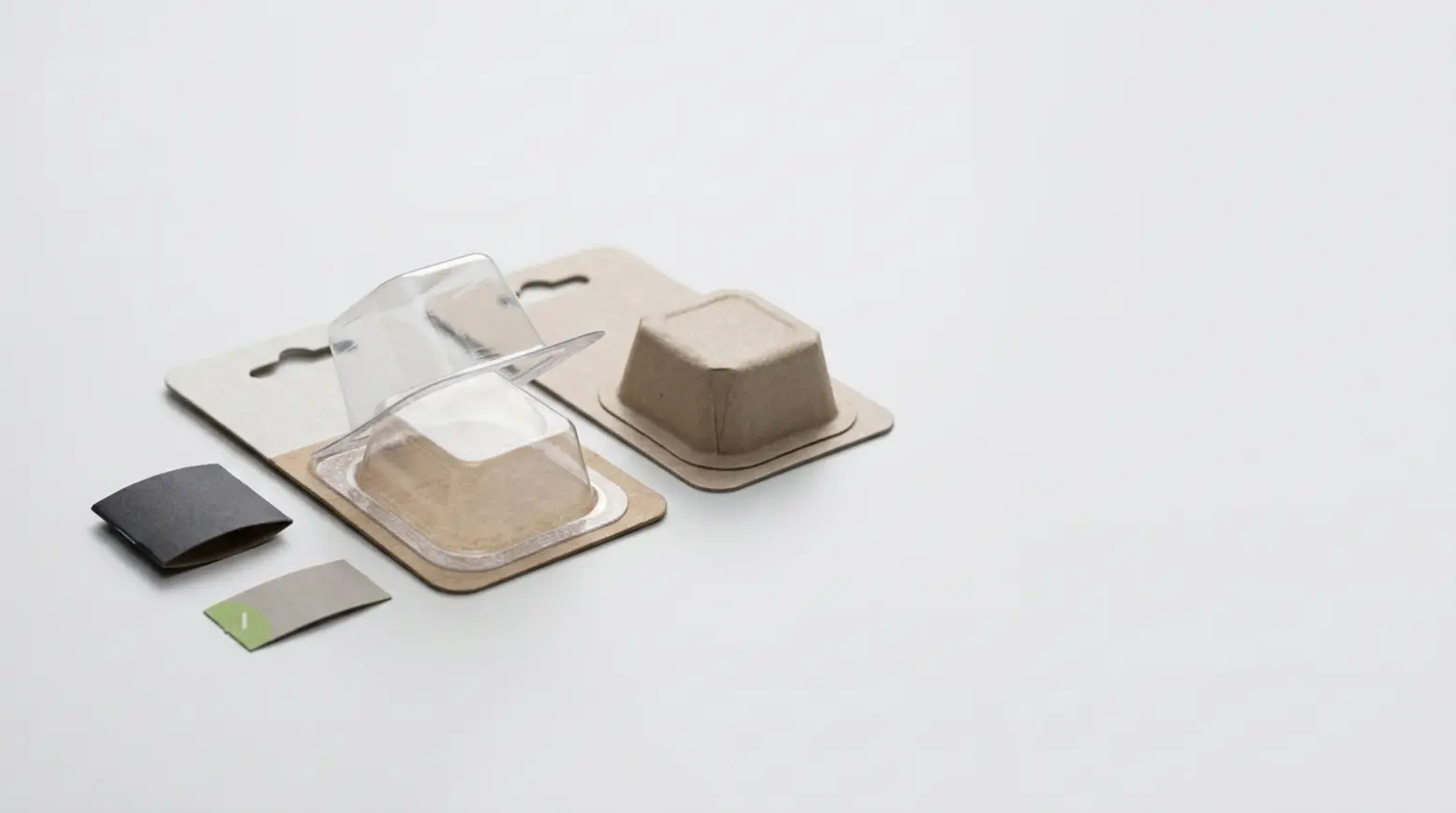
A two-material pack is not automatically a weak design. If the parts separate cleanly and each piece fits a suitable recycling stream, the structure can still perform excellently. This point is especially relevant in blister formats because the card and the cup serve different functions. The key question is a practical one: can the user, sorter, or recycler process the structure in a straightforward way? If the answer is yes, the design can still yield a favorable outcome even when utilizing more than one material.
Design details that deserve checking
Certain design details should always be reviewed early on because they can undermine a recycling case or create uncertainty within the model. Dark pigments, for instance, can affect sorting in some systems. Full-body sleeves might hide the main packaging material, and incompatible coatings can disrupt the recycling process entirely. Furthermore, very small parts can be difficult to recover. Discussions regarding EPR recycled content also belong in this phase because recycled content often factors into the wider fee calculation, though the exact impact ultimately depends on the specific market. An early review helps teams avoid late-stage changes and ensures a much more reliable estimate.
How to model eco-modulation EPR fees before new tooling
The ideal time to estimate fee impact is before the design freeze because that is when teams can still compare options without incurring major sunk costs. A straightforward model turns eco-modulation EPR fees into a practical purchasing question. It helps procurement compare recurring annual fees against artwork changes, testing, and tooling. While the result remains an estimate, it provides a much stronger basis for action than a decision made without data.
Step 1: List every pack component
Start with the current pack and document every part. This might include the cup, backing card, label, coating, insert, hanger feature, closure, or sleeve. For each part, note both the material and the weight. Ask your supplier for reliable component weights and a clear material breakdown. High-quality input data matters because a small error in part weights can significantly distort the fee model across high sales volumes.
Step 2: Multiply by expected sales per market
Add the expected unit sales for each market where the pack will be sold, keeping each market on a separate line. This is important because fee logic can vary greatly by country. A pack sold in Germany, France, and any other market should be modeled separately. In doing so, teams can clearly see the likely annual fee per market instead of mixing all volumes into a single number that obscures local differences.
Step 3: Add local fee logic and modifiers
Apply the local fee schedule to each material and component group. This step might include a base rate by material, plus a modifier linked to recyclability, separability, or another measurable feature. Some systems may reward a pack with a bonus for packaging recyclability, while others might add an EPR packaging malus adjustment. Always record your data sources and dates because regulations frequently change, and outdated assumptions can quickly weaken a business case.
Step 4: Build redesign scenarios
Create a few realistic options and compare them against the current structure. For example, one scenario might involve removing a large sleeve. Another could explore reducing the overall pack size, while a third might test changing the cup from PET to paper. A fourth scenario could increase the recycled content in a specific part of the pack. You can also test a design that keeps the existing materials but improves the physical separation between parts. These scenarios make the model genuinely useful by demonstrating exactly where the fee effects originate.
Step 5: Compare recurring fees with one-time costs
Separate your annual fee effects from one-time project costs such as tooling, testing, artwork changes, and validation work. This ensures the review remains clear for both finance and procurement teams. One redesign might require a larger upfront cost but offer much lower long-term fees. Another might deliver only a minor fee reduction yet improve the structure's compliance across multiple markets. This is exactly where eco-modulation EPR fees become a commercial decision rather than strictly a technical topic.
A simple example helps illustrate this. Imagine a blister pack featuring a PET cup, a printed card, a label, and a hanger feature. In the first redesign, the team removes a disruptive sleeve while keeping the rest of the pack largely similar. In the second redesign, the team changes the cup material entirely and reduces the overall pack size. In the third redesign, they increase the recycled content within one specific component. Each option alters the cost story in a different way, meaning the model should always compare the annual fee effect and the one-time implementation costs side by side.
| Component | Material | Weight | Units sold per market | Local fee factor | Modifier | Estimated annual fee effect |
| Cup | PET or paper | Enter grams | Enter units | Enter local rate | Enter bonus or malus if relevant | Estimate |
| Backing card | Board | Enter grams | Enter units | Enter local rate | Enter modifier if relevant | Estimate |
| Label or sleeve | Enter material | Enter grams | Enter units | Enter local rate | Enter modifier if relevant | Estimate |
Before finalizing the design freeze, it is highly beneficial to run a short decision check. Do you know every component and its corresponding weight? Are you aware of the exact material split? Do you know precisely where the pack will be sold? Do you understand the local EPR fee logic? Have you fully reviewed the labels, sleeves, coatings, pigments, and small attached parts? Asking these questions significantly reduces the risk of missing a major cost driver late in the development process.
Which packaging choices can improve eco-modulation EPR fees
There is no single best route for every product since the right answer ultimately depends on function, retail needs, target markets, and local regulations. Material comparisons should, therefore, be based on a robust model rather than simple assumptions. We design both cold-seal blister packs and paper-based options, allowing us to compare different structures both technically and commercially. This integrated approach helps teams review EPR packaging design choices using clear, actionable evidence.
When to compare a PET cup with a paper cup
Paper can be particularly useful when you want to test a simpler material story in the fee model. With all-paper packaging, the PET blister cup is completely replaced by a paper alternative, while many functional pack features remain in place. At the component level, paper blister cups give engineers a clear, standardized part to compare during scenario work. Still, paper is not always the lowest-fee option because coatings, extra components, overall weight, and specific local rules can heavily influence the final outcome.
Why a better plastic blister can still be the stronger option
A well-designed plastic blister can often perform much better than a paper pack featuring difficult coatings, weak separation mechanisms, or mixed components that severely complicate recycling. For this reason, paper and plastic should always be compared based on measurable pack properties and concrete market rules, rather than sweeping assumptions. In cold-seal formats, we utilize highly recycled cardboard paired with a water-based, solvent-free adhesive; you can read more about this within our sustainability approach. These types of details absolutely belong in the model because construction quality can matter just as much as the broader material family.
What measurable pack properties belong in the model
The model should strictly focus on data points that can be checked and compared objectively. These typically include separability, material split, total weight, component count, and recycled content. If you require further background on how recycled material is defined and assessed, our article on recycled content can help contextualize that portion of the review. This approach keeps the discussion practical, as the ultimate goal is to accurately estimate fee impacts and support smarter packaging fee reduction decisions using real-world inputs.
Eco-modulation EPR fees FAQ for brand teams, engineers, and procurement
This FAQ addresses the questions that most frequently arise during review meetings. In the majority of cases, the best approach remains quite simple: check the physical pack, research the specific market, and model the likely financial effect before seeking approval. Doing so provides internal teams with a vastly superior basis for cost, design, and procurement decisions.
Does paper always mean lower EPR fees?
No, because the full construction dictates the result. A paper-based pack utilizing difficult coatings, mixed materials, or parts that are notoriously hard to separate may not perform as well as expected. In certain cases, a cleaner plastic blister structure proves to be the stronger option when the local market assesses actual recyclability and practical material recovery.
Can recycled content lower the fee?
It certainly can factor into the wider fee logic, but the precise impact depends heavily on the market. Some systems afford recycled content much more weight than others. Therefore, it should be treated as just one measurable input within the broader model, rather than as a guaranteed cost saving.
What data do we need before a redesign decision?
You will need a full component list, the specific material type for each piece, the weight of each part, the expected unit sales broken down by market, and the local fee logic for each of those markets. It is also incredibly helpful to document any labels, sleeves, coatings, pigments, and small parts that could potentially affect recyclability or automated sorting.
What should we ask a packaging supplier for?
You should ask for highly reliable component weights, a clear material split, and a straightforward explanation of how the parts are assembled and whether they can be separated cleanly by the end user. If you are actively comparing two different design routes, ask your supplier to present both structures in the exact same format so your model remains consistent and the internal review is easier to follow.
If you are still weighing different options, securing a physical sample can be immensely helpful before you commit to expensive tooling. It allows brand teams to evaluate the shelf impact and the opening experience firsthand, while enabling engineers to inspect the structural integrity in real-world use. When you are ready to explore the next steps, you can easily request a sample to support your final decision.
Request a free sample now!


