

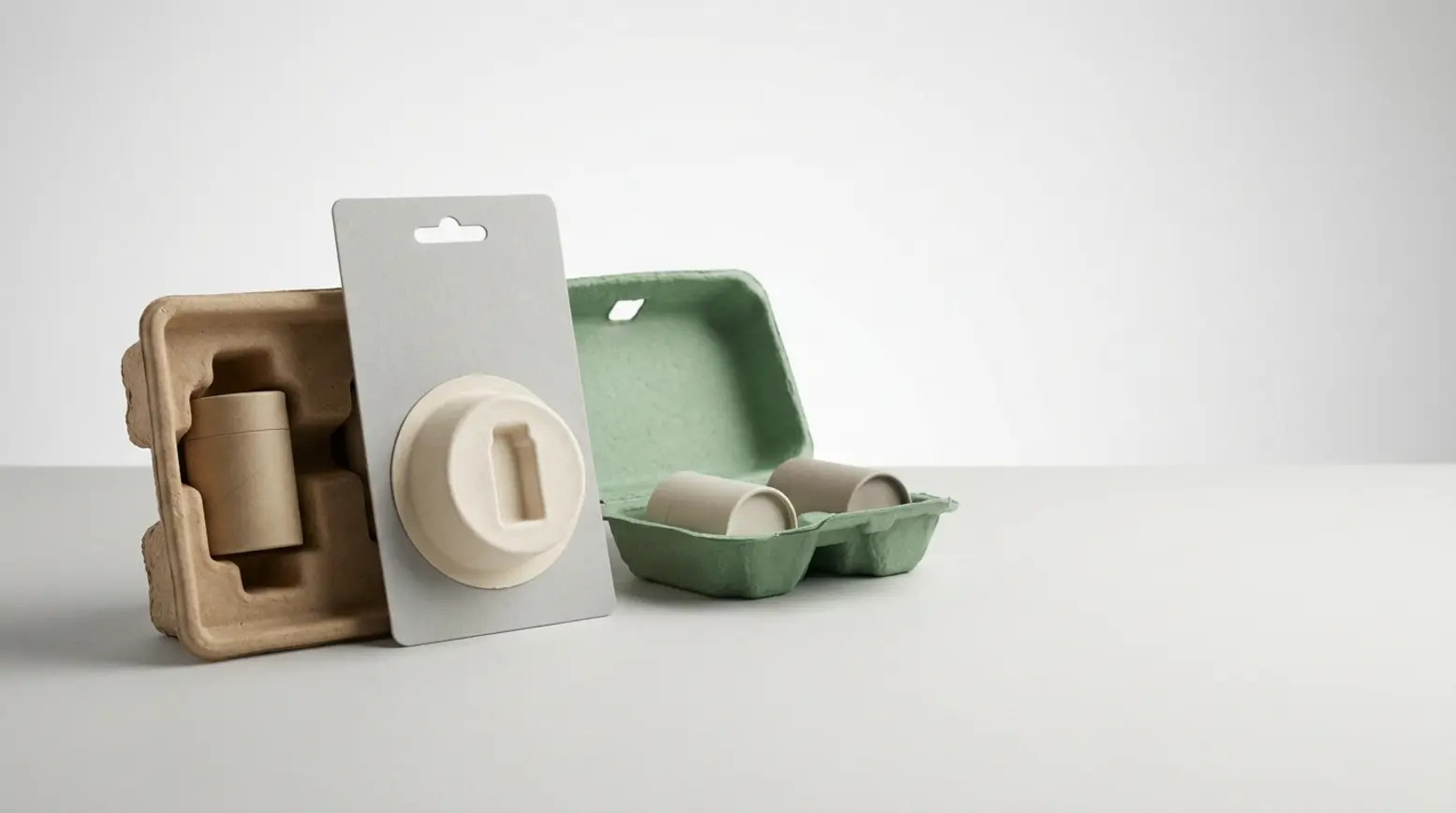

Formed paper packaging options generally fall into three distinct routes: molded pulp, formed paper cups, and paper trays. Because each format serves a different purpose, they are not interchangeable. Molded pulp typically protects or locates a product, while a paper blister cup creates a shaped retail cavity from paperboard. A tray, on the other hand, carries, groups, or positions products. The right choice depends on product shape, visibility, handling requirements, and protection needs, so it is best to make this decision before artwork is finalized.
• While molded pulp, formed paper cups, and trays all use paper or fiber, they solve entirely different packaging needs.
• A paper blister cup is often the best fit when you need a blister-style retail pack without using a plastic cup.
• A paper tray is typically chosen for transport, grouping, or repeatable product positioning.
• Early samples help teams verify fit, depth, finish, and visibility before the final design work begins.
What formed paper packaging options mean in practice
People often use a single broad term for several paper packaging formats, which can lead to inaccurate comparisons. In practice, the choice should start with the function of the pack rather than just the material. That is why formed paper packaging options should be reviewed as separate, distinct routes: molded pulp, formed paper cups, and paper trays. If you want to place this guide in a wider context, you can explore our all-paper packaging approach, which illustrates how these routes fit into a broader paper-based strategy.
Understanding these distinctions early on is crucial. Packaging engineers need to know what geometry is realistic, while brand teams must envision how the pack will look on the shelf. Similarly, procurement teams need to ensure they are requesting pricing for the correct route. Ultimately, a simple initial comparison can prevent significant delays later in the process.
Molded pulp within formed paper packaging options
Molded pulp is a three-dimensional part made from a fiber slurry that is formed and then dried. As one of the best-known types of fiber packaging, it is frequently used when protection, locating, or basic product support is the primary requirement. For instance, a molded pulp tray or insert can securely hold a product in place and reduce movement during handling.
This route is highly useful when cushioning and repeatable positioning matter more than a clear retail view. It is frequently part of molded paper packaging designed for protective inserts, inner packs, and transport support. The surface appearance can vary significantly because the pulp process, fiber mix, geometry, and tooling all influence the final result. Therefore, evaluating physical samples is essential. While a drawing can indicate size, it cannot fully convey the finish, fit, or the way the product feels in hand. If you need more detail on the process and its applications, our molded pulp packaging guide offers a deeper explanation.
Formed paper cups among formed paper packaging options
A formed paper cup is a component pressed from paperboard to create a blister-style retail pack. It forms a shaped cavity while ensuring that paper remains the visible formed material. This makes it a specific type of pressed paper packaging that should not be confused with molded pulp. This route is especially relevant when a brand desires a familiar retail structure that features a paper-based formed part. For a closer look at this format, you can review our paper blister cups designed for retail packaging.
This method is important because many retail products still require full enclosure, front-facing presentation, and a clear mounting position on a card. A formed cup can seamlessly integrate with printed blister cards, euro slots, product messaging, and cutout designs. It typically suits small electronics, cosmetics, office supplies, DIY accessories, and household items that require both shape and shelf presence. Within formed paper packaging, this is one of the most effective ways to retain standard blister logic while replacing the visible plastic cup.
However, there is a trade-off. Because transparency is lost, the consumer cannot view the product directly through the cup itself. Consequently, visibility must be established through strategic cutouts, print, layout, or the specific way the product is presented inside the pack. This is often a critical consideration for brand teams. The package can still communicate effectively, but the design strategy must account for this shift early on.
Technical checks are also vital. Board selection, cup depth, corner radius, product shape, and the required stiffness all dictate what is realistically possible. Deep cavities and sharp product features can impose structural limits, making early trials incredibly useful. This is where the choice between formed fiber and molded pulp becomes a highly practical question. Because pressed board yields a different look and distinct forming behavior compared to pulp, teams must test the exact route they plan to utilize.
Paper trays as formed paper packaging options
A paper tray is a formed or constructed paper-based carrier used primarily for transport, presentation, or product organization. It is defined first and foremost by its function. In many cases, the main goal is to place products in a repeatable position to make handling easier and more stable. Because of this, paper tray packaging is highly common for multi-piece sets, refill packs, grouped items, and products that must move smoothly through packing lines or store replenishment steps.
Tray design should always begin with product handling in mind. Teams should ask how items need to be located, separated, protected, stacked, or moved. A paper transport tray can significantly streamline assembly and packing because each item has a fixed designated space. If your requirement leans more toward carrying and organizing items rather than enclosing a single retail product, visiting our transport trays page is the best next step.
A tray fundamentally differs from a retail blister cup because it serves a completely different purpose. While a blister cup encloses a single product for shelf presentation, a tray supports transport, grouping, or open display. Although some tray designs are relatively simple, they still greatly improve repeatability and reduce handling issues. In this way, a well-designed tray supports the logistical process surrounding the product just as much as it supports the product itself.
How to choose formed paper packaging options for your product
You should choose molded pulp when cushioning, locating, or providing protective support is the main requirement. It is often a perfect fit for inserts and for certain transport applications where a molded fiber shape can hold the product securely in place. If a molded fiber route already suits your product's geometry, this can be a highly practical answer.
Select a formed paper cup when you want a blister-style retail format and a shaped paper cavity is technically realistic. This route works exceptionally well when the product requires secure enclosure and strong shelf impact, provided that visibility can be addressed through strategic openings, graphics, or the overall card layout. For many retail packs, the paper blister cup represents the closest paper-based alternative to a traditional plastic blister structure.
Opt for a tray when grouping, transport, or presentation requires a dedicated carrier. This is often the better route when multiple parts must remain organized or when repeatable positioning matters more than enclosing a single item. A well-structured tray can also improve internal handling efficiency because the products remain separated and easy to pick and place.
Ultimately, the final decision usually comes down to product shape, required visibility, surface appearance, protection level, handling steps, and production volume. Therefore, the best route is the one that fully supports the functional job of the pack, rather than relying solely on a material preference.
Simple comparison table for formed paper packaging options
Format: molded pulp. Main job: protection, cushioning, and locating. Visibility: usually low. Surface look: depends on the fiber mix, tooling, and manufacturing process. Early checks: fit, finish, cushioning effectiveness, and final size results.
Format: formed paper cup. Main job: retail enclosure and shelf presentation. Visibility: partial; usually created by cutouts or layout because the cup itself is not transparent. Surface look: pressed paperboard appearance. Early checks: depth, corner radius, board choice, structural stiffness, and product shape.
Format: paper tray. Main job: transport, grouping, and product organization. Visibility: open or partly open, depending on the design. Surface look: depends entirely on the tray's construction. Early checks: positioning accuracy, separation, handling efficiency, and stackability.
Questions about formed paper packaging options
Is molded pulp the same as a paper blister cup?
No, they are distinct routes utilizing entirely different forming methods and serving different functional jobs. Molded pulp is primarily used for protection, part locating, or inserts. Conversely, a paper blister cup is pressed directly from paperboard and is utilized specifically for blister-style retail packaging.
Can a formed paper cup replace a plastic blister cup?
In some cases, yes. The shaped cavity can remain, ensuring that the overall retail structure still feels familiar to consumers. However, because material transparency is lost, the product view must be resolved through intentional design choices such as cutouts, print graphics, or pack layout.
Is a tray always molded pulp?
No. A tray is defined primarily by its function and not by a single, fixed manufacturing process. While some trays are indeed made of molded pulp, others use entirely different paper-based constructions depending on the specific product, the handling requirements, and the necessary level of positioning.
What is the difference between formed fiber and molded pulp?
These terms are sometimes used loosely, which frequently causes confusion. In practical packaging work, molded pulp generally refers to a fiber part formed from a wet slurry that is then dried into shape. Other formed paper routes, such as pressed board cups, behave quite differently in both design limitations and final appearance. Therefore, it is far better to compare the actual packaging route being used rather than relying solely on broad material terminology.
When should we test samples?
You should test samples before the artwork is finalized. This is the optimal time to verify fit, depth, stiffness, finish, and overall product presentation. Prioritizing early sampling can drastically reduce costly rework, as selecting the wrong structure can negatively impact the entire pack design.
The next step before artwork is finalized
If you are currently comparing different routes, start by exploring an early structural concept or evaluating a physical sample. Doing so helps cross-functional teams review visibility, fit, handling, and overall feel long before final design files are created. It also provides engineers, brand managers, and buyers with a shared reference point, making it significantly easier to align on critical decisions. When you are ready to move from a conceptual comparison to a hands-on review, you can request a sample to assess the format with a physical pack right in front of you.
Request a free sample now!


