


Can an existing PET blister shape be reproduced in paper? Sometimes, yes, but rarely as a direct copy. While paper blister cups can form a true 3D cavity, paper blister cup forming has clear limitations because paper does not behave like heated plastic. Therefore, geometry must come first. Depth, wall angles, corners, undercuts, and repeatability all determine whether a shape is realistic, meaning sampling is typically required before a reliable quote can be provided.
• Paper blister cup forming can create a shaped paper cavity, but it cannot replicate every PET blister design.
• Geometry is the primary consideration because paperboard has limited stretch and is restricted by fiber direction.
• Deep cavities, steep walls, sharp corners, and undercuts increase the risks of cracking, wrinkling, and poor fit.
• The most common solution is a shape change, such as reducing the depth or smoothing transitions, rather than simply switching materials.
• The practical approach is straightforward: send the product or its dimensions, review a sample, and then decide if paper is the right material for the cup.
What paper blister cup forming means in simple terms
A paper blister cup is a formed paper component
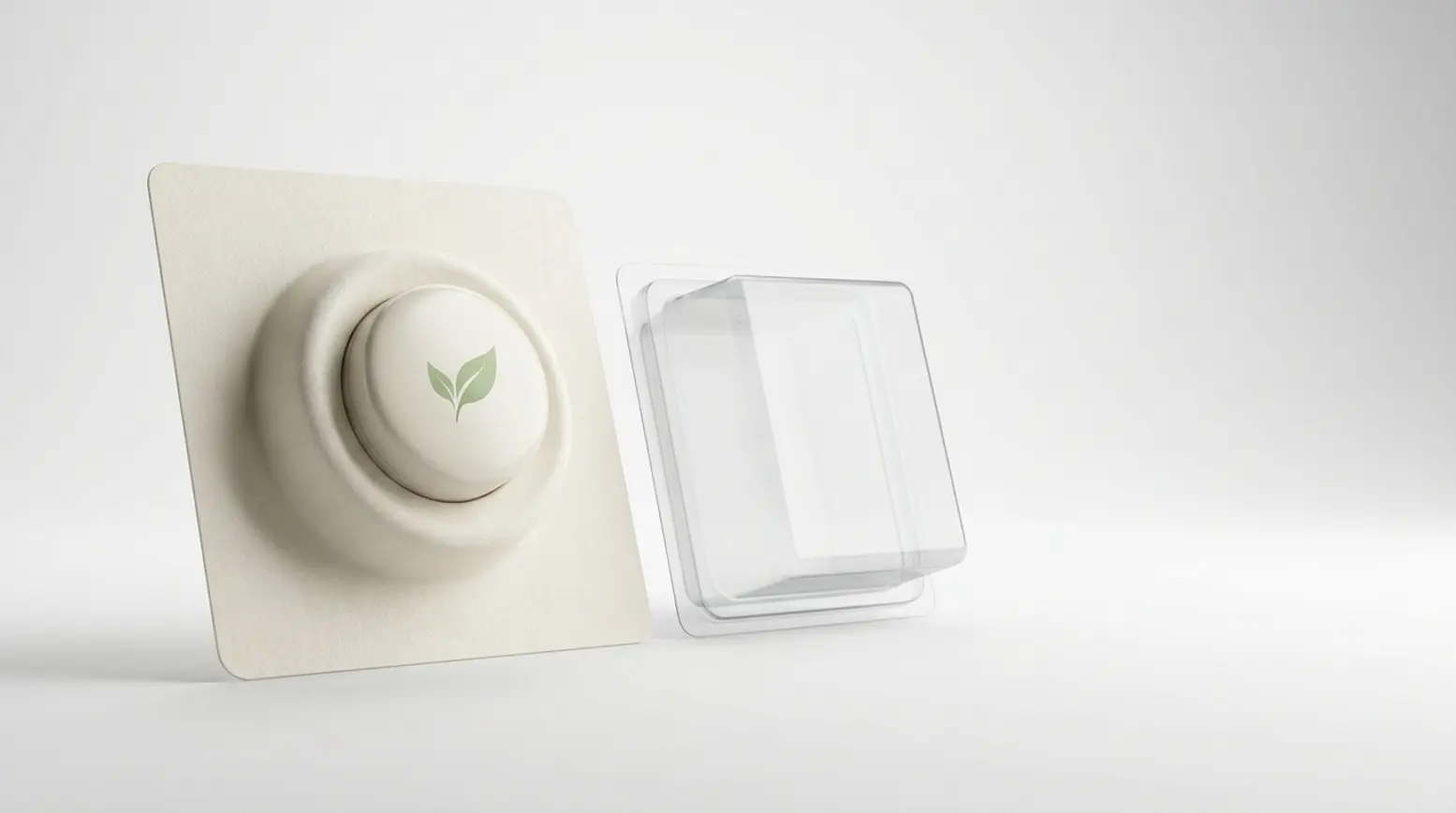
A paper blister cup is a paper-based component that holds a product securely inside retail packaging. It begins as a flat sheet and is molded into a cavity. This formed paper cavity ensures the product remains firmly in place, harmonizing both fit and presentation. Simply put, the cup replaces a traditional PET blister with a paper alternative that continues to support the product's position and the overall packaging structure.
Why paper does not form like PET
During paperboard forming, the material is guided and pressed into a tool to retain the required shape. PET behaves quite differently, as heated plastic can flow much more freely into complex details. Paper has less stretch and is heavily influenced by fiber direction, moisture, local pressure, and the tooling itself. Because of these factors, paper blister cup forming must be designed around the material's properties from the very beginning, rather than treating paper as a direct substitute for plastic.
Why paper blister cup forming starts with geometry
Limited stretch and fiber direction
Paper has a grain, meaning its fibers primarily run in a single direction. This significantly impacts how the board moves during the forming process. The material must transition into a 3D shape without tearing, folding, or retracting too much once formed. This retraction is often called springback, occurring when the part attempts to revert slightly to its original flat state. Board type, moisture levels, tooling, fiber direction, and final geometry all influence the outcome. Consequently, the limitations of formed fiber packaging cannot be distilled into a single rule or a simple depth ratio.
Why a PET blister shape often needs redesign in paper
A PET blister can typically maintain sharp details, steep walls, and tight corners far more easily than paper. Conversely, a paper blister cup usually requires a custom design because the material has less freedom to stretch and bend. If the original cavity is deep, narrow, or features abrupt shape changes, a direct copy is rarely feasible. In many cases, the best approach is to redesign the cup around the product and the specific geometric needs of paper, ensuring the packaging can be formed reliably and consistently.
The main geometry questions in paper blister cup forming
Depth relative to footprint
The first consideration is the depth of the cavity compared to its overall width and length. A greater forming depth forces the paper to travel further into the tool. This naturally increases the risk of cracking, poorly defined details, or uneven thickness. Generally, a wide and shallow shape is much easier to produce than a deep and narrow one. Checking this ratio is one of the most crucial early steps when evaluating paper blister design limits.
Wall angle and forming freedom
Wall angles are equally important because steep sides give the material less freedom to form smoothly. Wider, more open walls generally allow the board to settle into its shape with far less stress. This does not imply that every project requires the exact same angle. Rather, it means the wall design must harmonize with the board, the product, and the tooling to ensure a highly stable production process.
Corners and smoother transitions
Corners and transitions often determine whether a formed paper packaging concept is actually viable. Soft curves perform significantly better than sharp shifts because they distribute the load over a larger area. Sharp corners concentrate too much pressure in a single spot, drastically increasing the risk of failure. A similar issue arises when multiple abrupt shape changes are clustered together, causing localized strain to build up rapidly.
Why undercuts are difficult
Undercuts are shapes that hook inward, making the part difficult to release from the tool or challenging to load with a product. This poses a problem for paper and is especially tricky for deep-drawn paperboard concepts that require a stable release and a repeatable fit. Features that work seamlessly in plastic are often extremely difficult, if not completely unsuitable, in paper. Whenever this type of geometry is involved, creating a paper blister prototype is typically the best way to evaluate the actual risks before making any final decisions.
Why many sharp shape changes increase risk
When depth changes, corners, narrow zones, and steep walls are all concentrated in a small area, the material lacks the space to move in a controlled manner. This can trigger multiple problems simultaneously. The part might crack in one zone, wrinkle in another, and ultimately warp after forming. For this reason, the overall geometry of a paper cup should always be evaluated as a complete system rather than checking individual features in isolation.
Common failure modes in paper blister cup forming
Cracking when local strain gets too high
Cracking occurs when the material cannot stretch enough to follow the intended shape. This flaw most often appears near tight corners, sharp transitions, or excessively deep areas. Even a small crack can weaken the cup and alter the product's fit. Consequently, both protection and aesthetic appeal suffer, making repeatable production much harder to control.
Wrinkling when excess material cannot be controlled
Wrinkling occurs when excess material has nowhere to go during the forming process. Folds frequently appear along walls or around corners. While a wrinkle might sometimes be purely a visual defect, it can also disrupt how the product sits within the cavity. In a full production run, this can lead to severe consistency issues, as a single acceptable sample does not guarantee a stable manufacturing output.
Springback after the forming force is removed
Once the forming force is released, the cup may attempt to revert to its original flat state. This phenomenon is commonly known as springback. As a result, the final cavity might open up slightly or lose critical details. This is especially problematic when the cup needs to hold a product in a precise orientation, as even the smallest deformation can impact loading, package closure, and overall shelf appeal.
Inconsistent depth or shape in repeat production
A single sample might look perfect, but the manufacturing process must also yield reliable results time after time. If the depth or shape varies significantly between parts, it can result in a loose fit, assembly complications, or noticeable inconsistencies in the packaging. Repeatability is about achieving the exact same outcome every time, making it a critical focus for engineers, product teams, and procurement professionals. Therefore, paper blister cup forming should always be evaluated on both initial feasibility and long-term consistency.
How to improve paper blister cup forming when a shape does not work
Reduce depth where possible
The primary solution is typically a geometry adjustment. If the cavity is too deep for its footprint, slightly reducing that depth can provide immediate benefits. This limits how far the material needs to travel and drastically improves shape control. Adjusting the design is usually much more effective than simply swapping the paper grade, as the shape itself is the main driver of the material's forming behavior.
Open the wall angle
Steep walls quickly expose the limitations of any molded paper cup packaging or formed paper blister cup concept. Opening the wall angle gives the board the necessary freedom to stretch into place. This adjustment minimizes localized stress and allows the cup to release much more cleanly from the tooling. In the long run, it also paves the way for highly stable production.
Soften transitions and corners
Softer transitions significantly reduce the risk of cracking while simultaneously enhancing surface quality. Even minor geometric tweaks can make a massive difference by spreading stress more evenly across the formed area. If the product's shape allows it, introducing rounded features is often a highly practical improvement. This fundamental difference is exactly why a cup must be developed uniquely as a paper component, rather than just copying an existing PET cavity.
Test the real product shape before final decisions
The actual physical product should always be your primary reference point, as its true contours, specific fit points, and intricate details dictate whether a cavity shape will work. While a drawing is helpful, it rarely exposes the hidden risks associated with tight corners, depth variations, or loading constraints. Early testing saves immense time down the line, confirming the viability of a concept before artwork and tooling are finalized. For procurement teams, this perfectly illustrates why physical sampling must typically precede any dependable quote.
Which products suit this route best
Easier case: compact product with soft contours
Compact products with smooth edges and limited depth are generally the easiest to convert. Great examples include small cosmetics, lip balms, or any other items featuring gentle contours. Because the necessary cavity geometry is simpler, the material is able to form much more evenly. These types of products are highly suitable candidates for a transition from a PET cup to a paper alternative.
Harder case: deep narrow product or hard undercuts
A deep and narrow product is considerably more difficult because the cavity must stretch downward without sufficient width to support proper material flow. Hard undercuts introduce another layer of complexity, as the cup still needs to form easily, release cleanly, and hold the item securely. In such scenarios, a thorough redesign might be required. Occasionally, a completely different packaging concept, or even sticking with a traditional plastic blister, proves to be the better choice. Recognizing these limitations early on enables teams to make faster, more informed decisions.
When paper blister cup forming is the right route
What changes when the PET cup is replaced
Replacing a PET cup with paper fundamentally alters the material composition of the package. While this shift certainly supports broader sustainable packaging choices, technical limitations still apply. Paper simply cannot match PET when it comes to transparency, razor-sharp edge detailing, or the flexibility to accommodate highly complex shapes. However, if the geometry proves suitable, the transition fits seamlessly into our wider all-paper packaging solutions for retail products.
Formed paper cups and molded pulp are different routes
It is important to note that formed paper cups and molded pulp utilize entirely different processes. A paper blister cup is formed from a continuous sheet of paperboard, whereas molded pulp relies on completely different material behaviors and design principles. If you are interested in comparing the two, our molded pulp packaging guide breaks down that specific methodology. Distinguishing between these options helps development teams choose the correct path and prevents any confusion between similar fiber-based materials.
The practical next step
Why the real product is needed for testing
The actual physical product reveals far more than a simple sketch ever could. It exposes the true contours, minute details, and critical fit points that dictate the success of the package. Consequently, physical sampling remains the best way to determine true feasibility. It allows engineering, product, and procurement teams to evaluate the exact same physical prototype, facilitating grounded discussions regarding fit, aesthetics, and potential production risks.
From dimensions to sample to decision
The process is remarkably simple. Send us the product, or provide accurate dimensions if the physical item is not yet available. We will then develop the initial cup shape, produce a sample for review, and collectively decide if paper is truly the right material for the job. If you are ready to explore this option, you can request a sample to evaluate the fit, structural appearance, and tactile quality of the paper surface long before any major production commitments are made.
FAQ
Can every PET blister cup be converted to paper?
No. Many PET shapes are simply too deep, sharp, narrow, or complex to be directly translated into a paper format. While paper can certainly be molded into a true 3D cavity, it lacks the extreme pliability of heated plastic. Because of this inherent difference, most conversions require a thoughtful redesign first.
What makes a paper blister prototype fail?
The most common culprits include excessive stress in a single area, poor material flow, overly steep walls, sharp corners, restrictive undercuts, or disproportionate depth relative to the footprint. These failures typically manifest as cracking, wrinkling, aggressive springback, or wildly uneven depth. In almost every scenario, a geometric adjustment is the first line of defense, as the underlying shape is usually what drives the problem.
Why is a sample needed before quotation?
Providing a reliable quote depends heavily on the specific requirements of the chosen shape. Factors such as board choice, tooling complexity, overall geometry, necessary testing, and expected repeatability all influence the final price. Creating a sample proves whether the cup can form correctly, accommodate the product seamlessly, and maintain stability throughout a production run. Therefore, rigorous testing must nearly always precede a formal quote.
When should molded pulp be considered instead?
Molded pulp becomes a strong alternative when the packaging concept aligns better with that specific manufacturing process, or when the product's geometry simply does not suit a formed paper blister cup. It is an entirely separate approach, governed by unique material behaviors and distinct design rules. This decision should be made carefully; although both options are fiber-based, they function in completely different ways.
Request a free sample now!


